
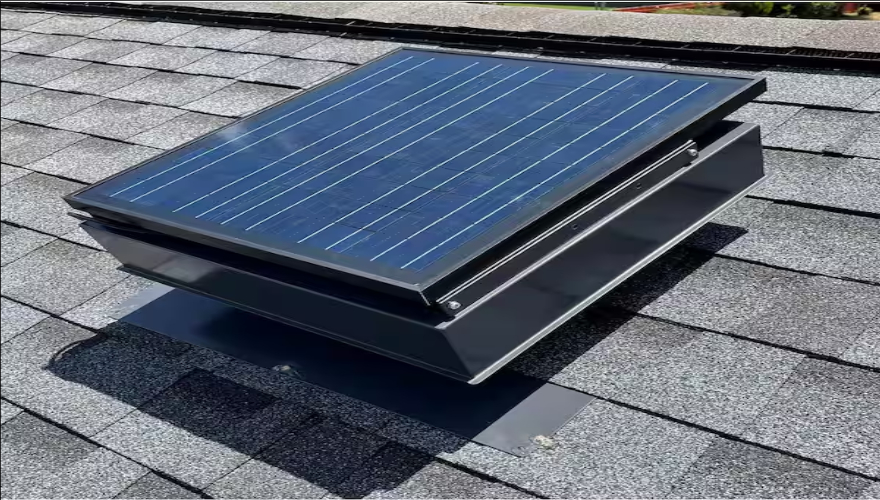
In hot, humid environments, stagnant air can quickly make a small space uncomfortable. But a solar exhaust fan offers an alternative that relies on sunlight to power ventilation, making it especially appealing for spaces without easy access to grid electricity.
Unlike a regular fan, which primarily circulates air within a room, a solar exhaust fan is designed to remove hot, stale air and promote natural airflow. Venting trapped heat and drawing in fresher air improves air quality while reducing indoor temperature. Therefore, understanding how a solar exhaust fan differs from a regular fan helps users select the right solar product for cooling and ventilation.
How a Solar Exhaust Fan Works Compared to a Regular Fan
A solar exhaust fan operates using a solar panel that converts sunlight into electrical energy. This energy powers a DC motor, which drives the fan blades to expel hot air from an enclosed space. As warm air exits, cooler outside air naturally replaces it, creating continuous ventilation. The process is simple, quiet, and requires no connection to the electrical grid.
In contrast, a regular fan relies on household electricity or batteries. Its primary function is to move air around a space rather than remove it. While this air movement can create a cooling sensation on the skin, it does not lower the actual temperature or remove humidity. Heat remains trapped, especially in enclosed or poorly ventilated areas.
Another key difference lies in the fact that Solar exhaust fans are designed to push air outward, often through a wall, window, or roof mount. Regular fans typically blow air in a fixed direction and are intended for personal comfort.
Energy Source and Operating Costs: Solar Power Versus Electricity
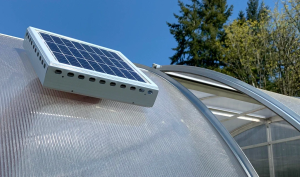
A solar exhaust fan runs on free solar power, drawing energy directly from sunlight. Once installed, it operates without adding to electricity bills. This makes it particularly valuable for remote structures, agricultural buildings, or seasonal installations where running power lines is inconvenient or costly.
Regular fans depend entirely on grid electricity or replaceable batteries. While they are affordable upfront, long-term operation increases energy consumption, mainly when used continuously during hot weather.
Solar fans may also include battery backup options, allowing limited operation during cloudy weather or at night. Although performance is strongest under direct sunlight, modern solar products with higher-wattage panels can deliver consistent airflow even on partially cloudy days.
Design, Installation, and Application Differences
Solar exhaust fans are typically compact, durable, and built for outdoor or semi-outdoor environments. Many models use weather-resistant ABS plastic and include safety guards, waterproof ratings, and anti-backflow features to prevent rain or wind intrusion. Installation options range from window-mounted units to roof-mounted exhaust systems, depending on the application.
Regular fans are generally designed for indoor use. Floor, desk, and wall-mounted fans are intended to be portable or semi-permanent and are not usually rated for outdoor use. Their installation is straightforward but limited to areas with power access and adequate safety conditions.
In terms of application, solar exhaust fans excel in spaces where ventilation is more important than direct airflow on people. Chicken coops benefit from reduced moisture and odors, greenhouses maintain healthier plant environments, and attics experience lower heat buildup, helping protect roofing materials. Regular fans, by comparison, are better suited for living spaces where immediate airflow improves comfort but does not address underlying heat accumulation.

Performance, Airflow, and Environmental Impact
Solar exhaust fans are optimized for steady ventilation. Their purpose is to exchange air efficiently over time, gradually reducing heat and humidity. Higher-quality models with efficient brushless DC motors can move a surprising amount of air, especially when paired with higher-wattage solar panels.
Regular fans can produce stronger airflow, making them effective for creating a cooling breeze. However, this airflow does not remove heat or moisture from the space. As a result, the environment may still feel warm once the fan is turned off.
From an environmental standpoint, solar fans operate silently, produce no emissions, and rely entirely on renewable energy. Regular fans, while relatively efficient, still contribute to electricity demand and may generate noise during operation.
Choosing the Right Solar Exhaust Fan for Your Needs
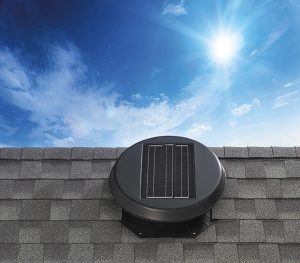
Selecting the right solar exhaust fan involves evaluating several practical factors. Panel wattage is one of the most important considerations, as higher wattage provides stronger and more consistent airflow. For small sheds or pet houses, a basic model may suffice, while greenhouses and attics often benefit from higher-powered units.
Battery backup can add flexibility, especially in regions with variable sunlight. Waterproof ratings such as IP65 or IP67 are essential for outdoor installations, ensuring reliable operation in rain or humid conditions. Safety features, including fan guards and anti-backflow valves, protect both users and the internal components of the fan.
Regular fans, on the other hand, require minimal selection criteria beyond size, airflow strength, and noise level. While convenient, they may not address ventilation challenges in enclosed spaces. Solar exhaust fans are designed to ventilate, remove heat, and improve air quality in enclosed spaces using clean, renewable energy. Regular fans focus on air circulation and immediate comfort, making them suitable for occupied indoor spaces but less effective at addressing heat buildup or humidity. While both products serve valuable roles, they are not interchangeable.