
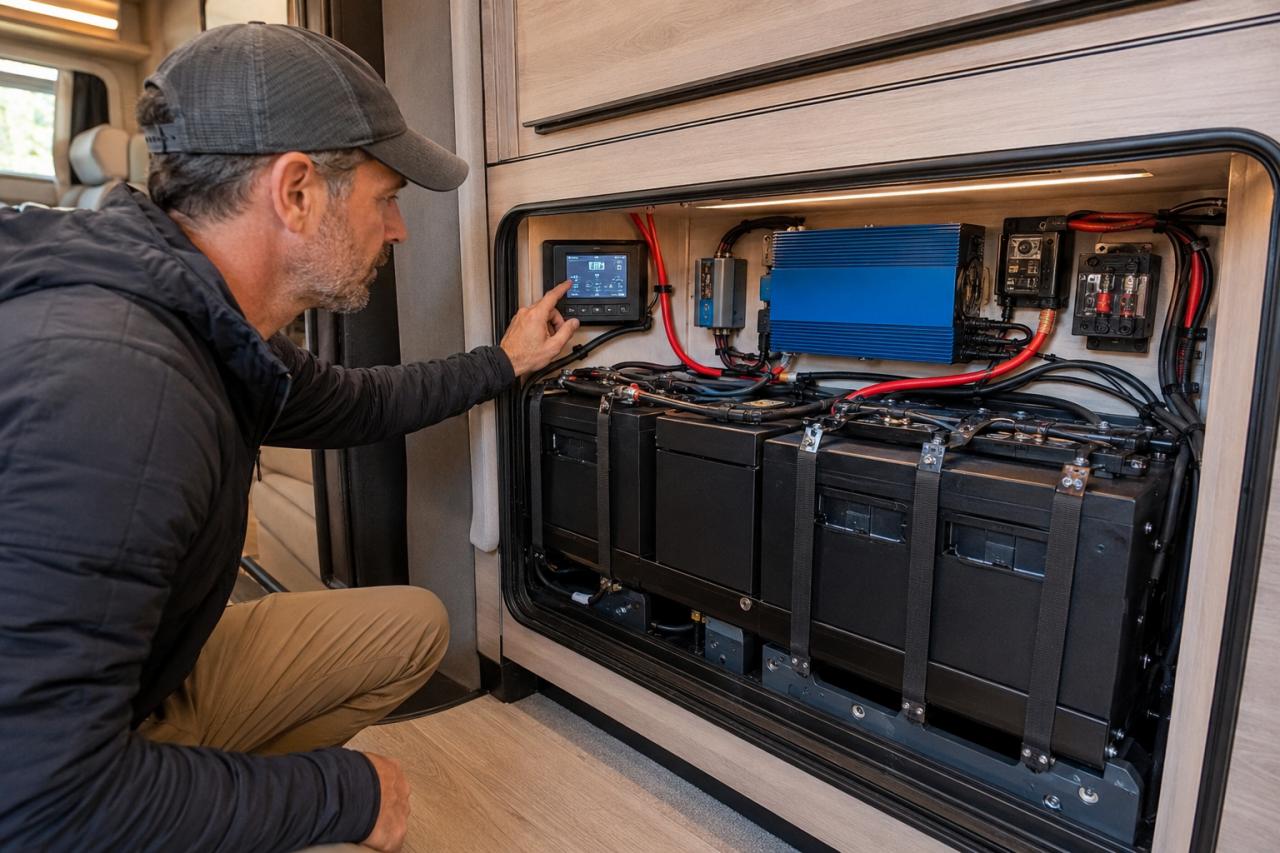
A motorhome gives you freedom only when its power system can keep up with the trip. Lights, fridge, water pump, fan, phone chargers, laptop, Wi-Fi router, and small kitchen devices all draw from the same battery bank. If the system is too small, every evening becomes a boring power-saving game. If it is too large, the owner pays for battery capacity that may never be used. Solar battery storage capacity for a motorhome should be based on daily energy use, usable battery capacity, solar charging speed, and travel habits. The right size depends less on the vehicle itself and more on how people live inside it when shore power is unavailable.
Start with Daily Motorhome Power Use
Battery sizing should start with real loads, not guesses. List every device used in the motorhome and estimate how long each one runs per day.
Use this formula:
Watts × Hours = Watt-hours
A 40W fan running for 5 hours uses 200Wh. A 60W laptop charger running for 3 hours uses 180Wh. Small devices look harmless until they gather together like a tiny electrical rebellion.
A normal daily setup may look like this:
| Device | Power | Runtime | Daily Use |
|---|---|---|---|
| LED lights | 30W | 5 hours | 150Wh |
| DC fridge | 45W average | 12 hours | 540Wh |
| Water pump | 60W | 0.5 hour | 30Wh |
| Phone charging | 20W | 3 hours | 60Wh |
| Laptop | 60W | 3 hours | 180Wh |
| Roof fan | 35W | 6 hours | 210Wh |
| Wi-Fi router | 10W | 8 hours | 80Wh |
This example uses about 1,250Wh per day before losses. After inverter loss and charging inefficiency, the actual daily demand may reach 1,400–1,600 Wh.
Convert Solar Battery Storage Capacity into Usable Energy
Battery capacity is often shown in amp-hours, but motorhome planning works better in watt-hours.
Use this formula:
Battery voltage × Amp-hours = Watt-hours
A 12V 200Ah battery provides:
12V × 200Ah = 2,400Wh
That number is the nominal capacity. It does not mean that all 2,400 Wh should be used. Usable energy depends on battery chemistry.
A lithium battery often allows around 80–90% usable capacity. A lead-acid battery is usually kept at a depth of discharge near 50% to protect its cycle life.
So a 12V 200Ah battery may provide:
- Lithium: about 1,900–2,100Wh usable
- Lead-acid: about 1,200Wh usable
This is why two batteries with the same amp-hour rating can perform very differently. The label may look similar, but the real motorhome runtime is not the same.
Match Solar Battery Storage with Solar Panel Charging
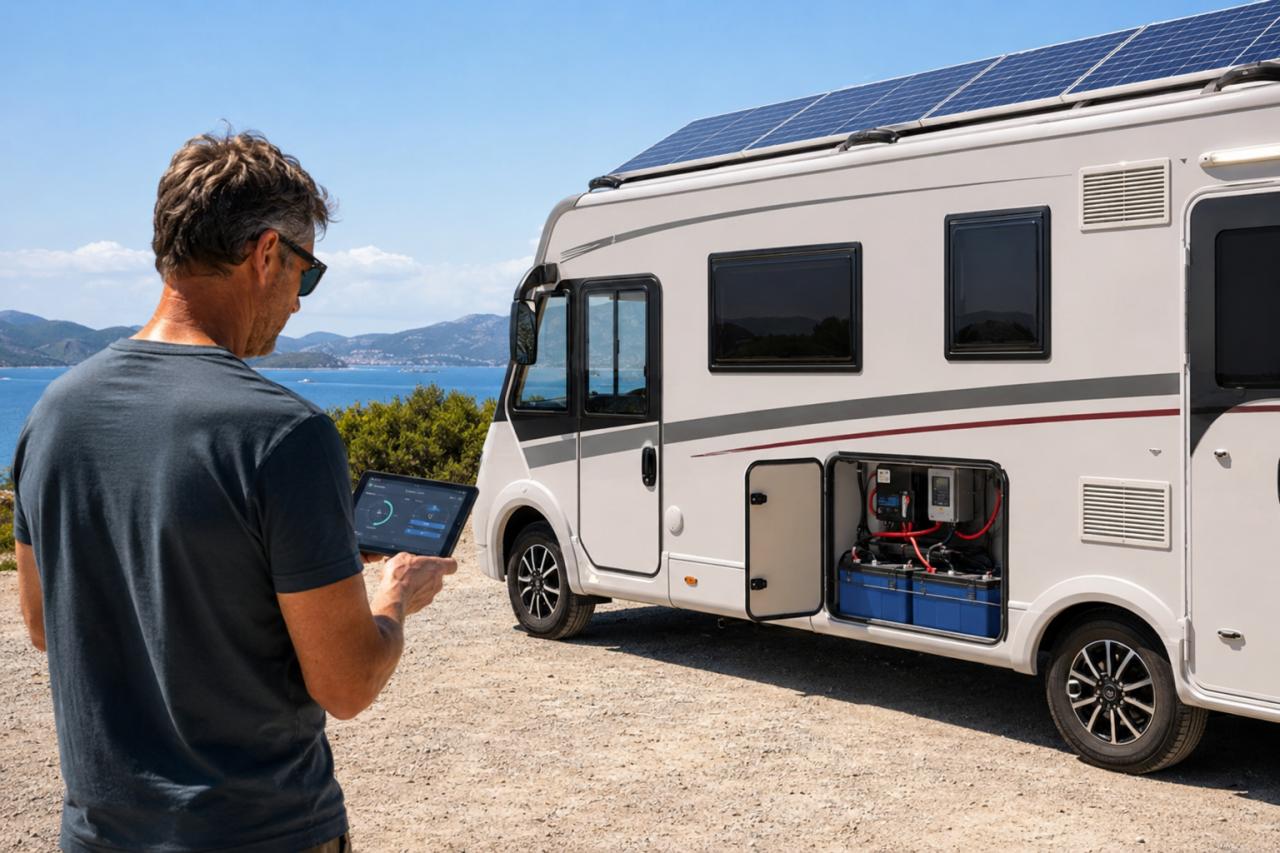
Solar battery storage only works well when the panels can recharge it fast enough. A large battery bank is not useful if the solar array cannot refill it during normal travel conditions.
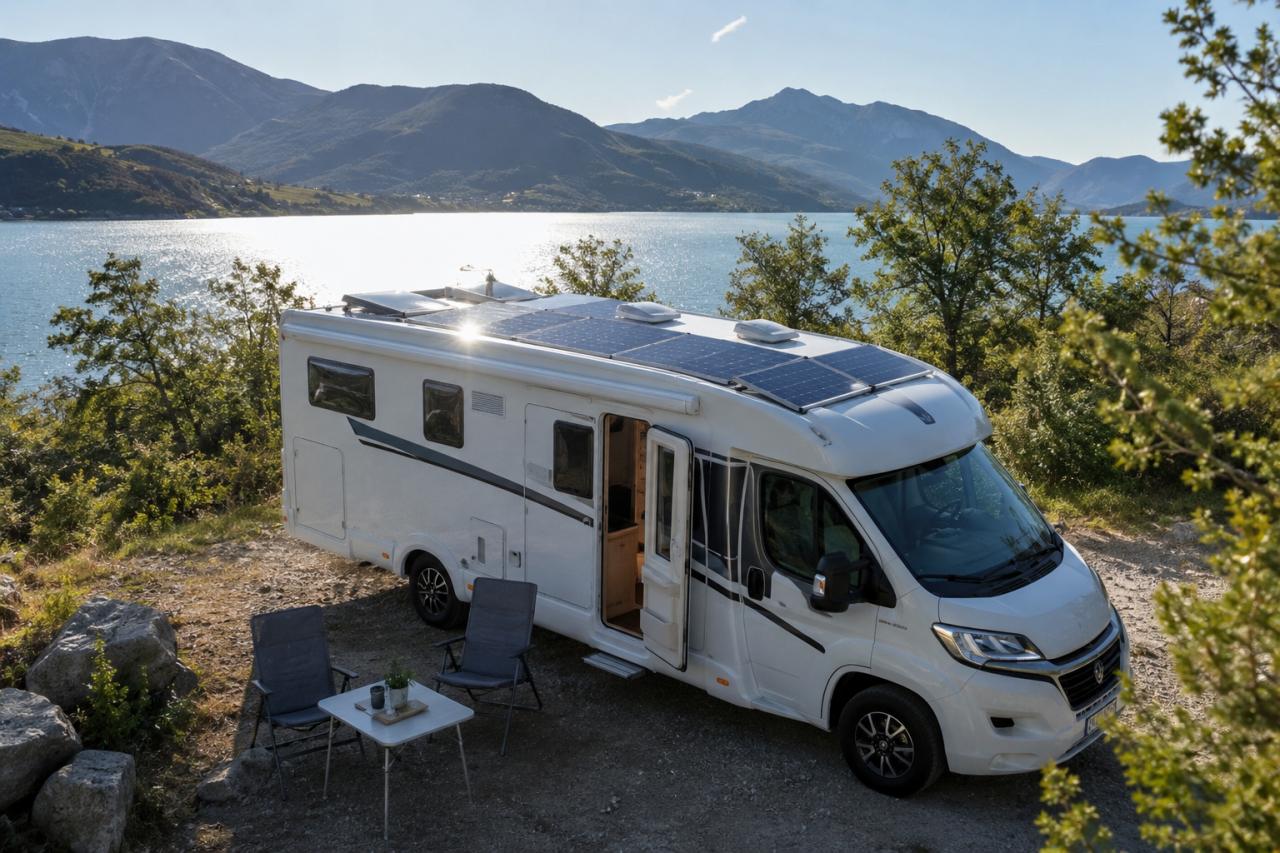
A 400W solar array does not produce 400W all day. Heat, sun angle, dust, wiring losses, and controller efficiency reduce the actual output. A practical estimate is:
Panel wattage × peak sun hours × 70% = daily solar input
For example:
400W × 4 hours × 0.7 = 1,120Wh per day
If the motorhome uses 1,600 Wh per day, a 400W array may not keep up. The battery will slowly drain unless the owner drives with alternator charging, plugs into shore power, reduces loads, or adds more solar panels.
A reliable Solar Board setup can help support motorhome charging when panel size, installation angle, and battery capacity are planned together. For broader solar planning, the U.S. Department of Energy’s solar guide explains how solar systems can integrate storage to keep generated energy available for later use.
Add a Safety Margin to Solar Battery Storage Capacity
Motorhomes rarely operate under perfect test conditions. Clouds reduce charging. Trees shade the roof panels. Cold weather can reduce battery performance. Inverter losses take part of the stored energy before appliances receive it.
A practical system should add 20–30% extra capacity above the calculated daily load.
If daily use is 1,500Wh, then:
1,500Wh × 1.3 = 1,950Wh
That means the motorhome should have around 2kWh usable capacity for one day of light-to-normal use. For two days without strong solar charging, the system would need around 4kWh usable capacity.
This margin also protects battery health. A battery bank that runs near empty every night will age faster than one operating with reserve capacity.
Check the Whole Motorhome Power Setup
Battery storage controls runtime, but the rest of the system decides how usable that stored energy really is. The inverter must handle AC appliances. The solar panels must recharge the battery. The wiring, controller, and protection devices must safely support the current.
A motorhome power system should match three parts:
- Battery capacity for runtime
- Inverter output for appliance demand
- Solar input for daily recharge
If these parts do not match, the system creates strange problems. A large battery may still fail to run a high-wattage appliance. A large solar array may recharge slowly if the controller is undersized. A small inverter may shut down even when the battery is full. Human beings keep discovering that connected parts must actually work together. Shocking development.
For users comparing products before building a motorhome system, the Solar Shop page is a useful place to review related solar panels, portable power stations, chargers, and inverters in one place.
Common Solar Battery Storage Ranges for Motorhomes
For light weekend use, 1–2kWh usable capacity may be enough. This supports lights, phone charging, a fan, water pump use, and limited fridge operation. It works best when the motorhome is driven often or plugged in at campsites.
For regular off-grid travel, 2–4kWh usable capacity is a more practical range. It can support a fridge, lights, fans, phones, laptops, a router, a water pump, and small electronics.
For heavy appliance use, 5kWh or more may be needed. This applies when the owner expects to run a microwave, electric kettle, induction cooktop, or air conditioner. At that level, the inverter and solar array must also be upgraded.
If the motorhome setup is part of a wider off-grid or backup energy plan, HomeSolars can help connect solar panels, batteries, inverters, and accessories into a more complete power system, rather than treating each product as a lonely little box with wires.

Solar Battery Storage Capacity Requirements for a Motorhome
Most motorhomes need 2–4kWh of usable solar battery storage for regular off-grid travel. This range supports the daily devices most travelers actually use, including a fridge, lights, fans, phones, a laptop, a water pump, and a router. A light weekend setup may work with 1–2kWh. A motorhome that uses high-wattage appliances or stays off-grid for longer periods may need 5kWh or more. The safest method is simple: calculate daily watt-hours, convert battery capacity into usable energy, add 20–30% reserve, then check whether the solar panels can recharge the battery during normal travel. A motorhome power system works well only when storage capacity, solar input, and inverter output match the way people actually live on the road.