
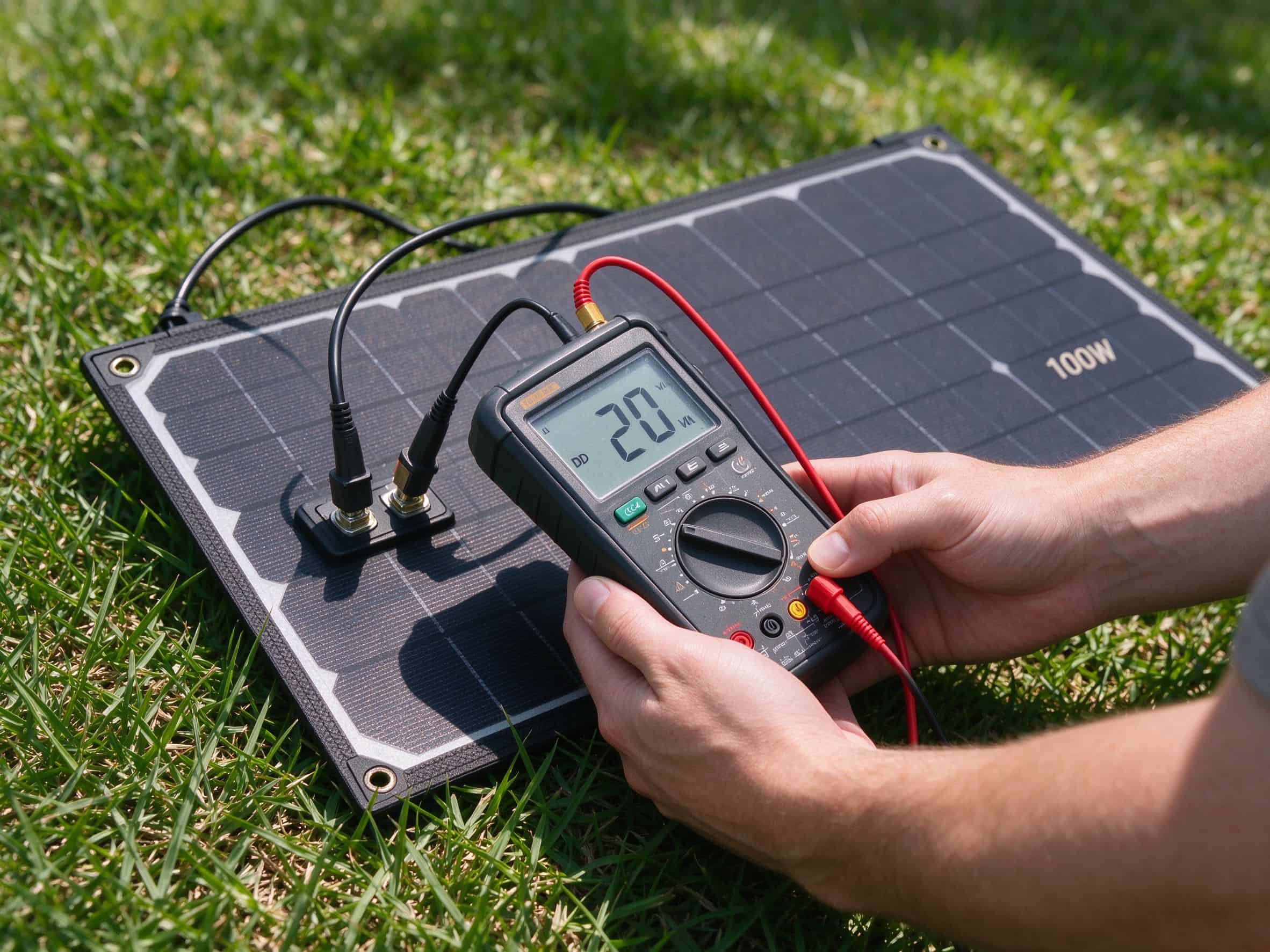
Testing your solar panel power output takes about 15 minutes and a cheap multimeter. You do not need a lab or a clamp meter. You just need the panel in direct midday sun, a multimeter set to DC volts and amps, and the panel’s spec sheet in hand. The numbers you read tell you whether your panels are underperforming because of dirt, shade, a bad diode, or a wiring fault — before you spend money on a new charge controller or a bigger battery.
You Need Before Starting to Measure Solar Panel Power Output
You only need three things.
- First, a basic digital multimeter that reads DC volts up to at least 60V and DC amps up to 10A or 20A. Most 100W to 400W panels fall inside that range.
- Second, check the panel’s spec sheet, either the sticker on the frame or the page you downloaded when you bought it. You need four numbers from it: Vmp, Imp, Voc, and Isc.
- Third, a clear patch of direct sun between roughly 10 a.m. and 2 p.m. local time. Cloud cover, low winter sun, or shade on even one cell throws the reading off enough that the test is not worth doing.
Safety matters more than people expect. A 24V panel can push close to 40V in bright sun, which will not kill you but will make you jump. Keep one hand in your pocket when you probe the terminals, and never let the two probes touch each other while the panel is in the sun. If the panel is part of a roof array, wear a harness and do not lean over the edge.
The Key Numbers on the solar panel power output Spec Sheet
A panel’s sticker lists four numbers, and each one answers a different question about how the panel is behaving. Mixing them up is the most common mistake first-time testers make.
Open-circuit voltage (Voc) is the voltage the panel produces when nothing is connected to it. It tells you whether the panel is alive at all. Short-circuit current (Isc) is the current you read when you touch the two probes directly across the output. It tells you how much sunlight the panel is actually catching. Both numbers are easy to measure with a multimeter, and both are printed on the spec sheet under STC — Standard Test Conditions, which assume 1000W per square meter of sunlight, a 25°C cell, and an air mass of 1.5.
Solar panel output: Maximum Power Voltage and Current
Maximum power voltage (Vmp) and maximum power current (Imp) are the numbers the panel actually works at when it is connected to a solar charge controller and a battery. Multiply Vmp by Imp, and you get the rated wattage, usually written as Pmax. You cannot measure Vmp and Imp directly with just a multimeter, because they only appear when a load is attached. But you can check Voc and Isc and compare them to the spec sheet. If both read within about ten percent of rated, the panel is healthy, and your real-world solar panel power output is normal.
Step-by-Step Test Procedure
Once the panel is in the sun and the spec sheet is open, the test itself takes five minutes. Work slowly, and write each number down before you move on.
Lay the panel flat on the ground or angle it straight at the sun. No leaves, no branches, no shadows from your own body on the glass. Wait two minutes before you read anything. The cells need a minute to stabilize after they come out of shade. If you are testing a roof array, make sure no vent pipe, chimney, or tree edge falls across even one cell during the test.
Measure Open-Circuit Voltage
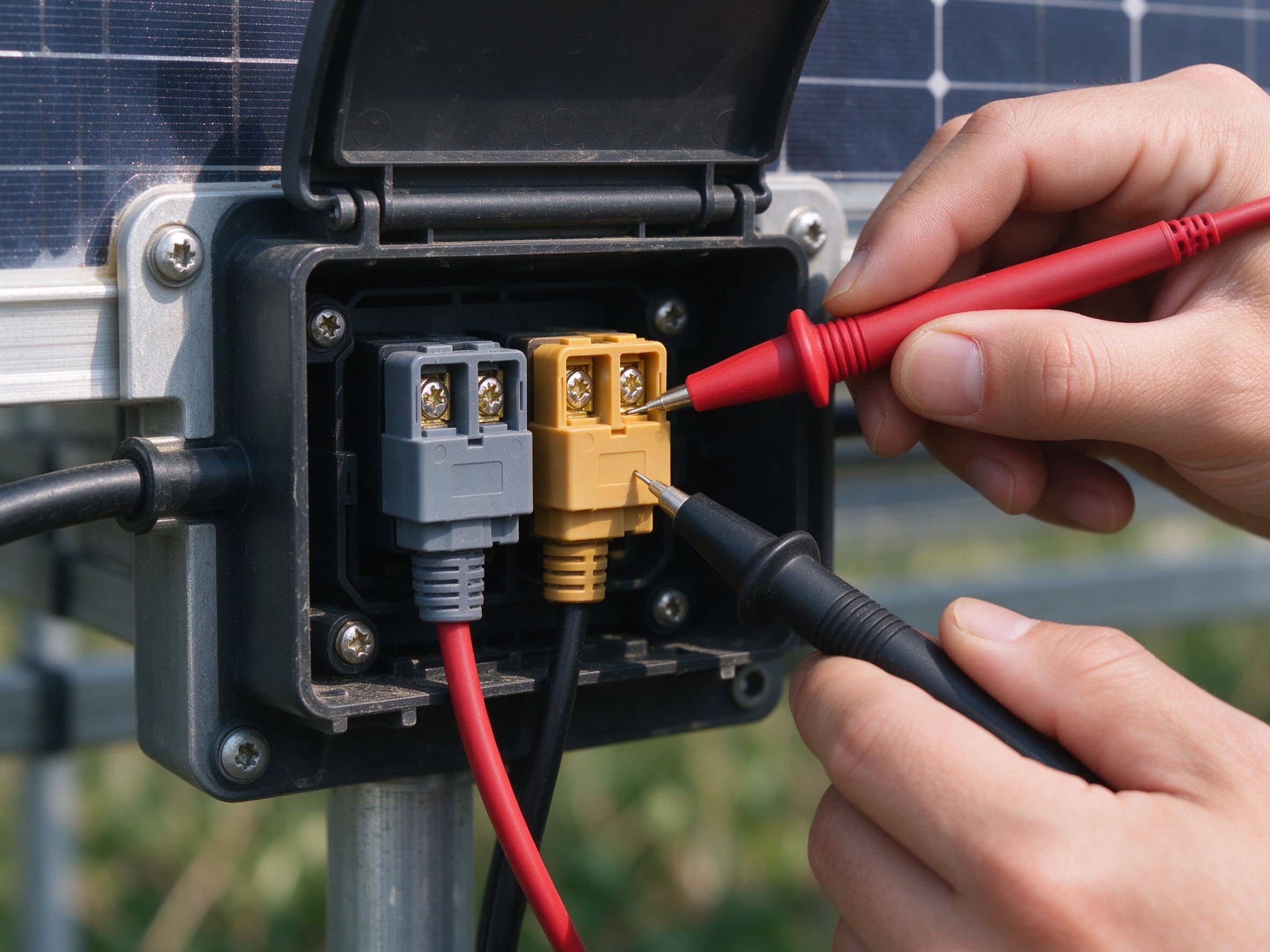
Set the multimeter to DC volts. Touch the red probe to the positive MC4 terminal and the black probe to the negative. The reading should settle within a few seconds. Compare it to the Voc on the spec sheet. On a bright cold morning, expect to read slightly higher than rated, because panels produce more voltage when cells are cool. On a hot afternoon on a black roof, expect to read slightly lower. A reading within ten percent of the rated Voc is normal. A reading close to zero means the panel is dead, the diode failed, or the wiring came loose.
Measure Short-Circuit Current
Move the red probe to the 10A or 20A DC jack on the multimeter. Keep the black probe in the common jack. Set the dial to DC amps. Touch the probes across the output again. The reading should hold steady near the rated Isc. Do not leave the probes connected for more than a few seconds, because you are effectively shorting the panel. Compare the number to the spec sheet. If Isc is low but Voc is fine, the panel is being shaded, dirty, or seen through weak sunlight. If both are low, the panel itself has a problem.
Why Your Solar Panel Output Reads Lower Than Rated
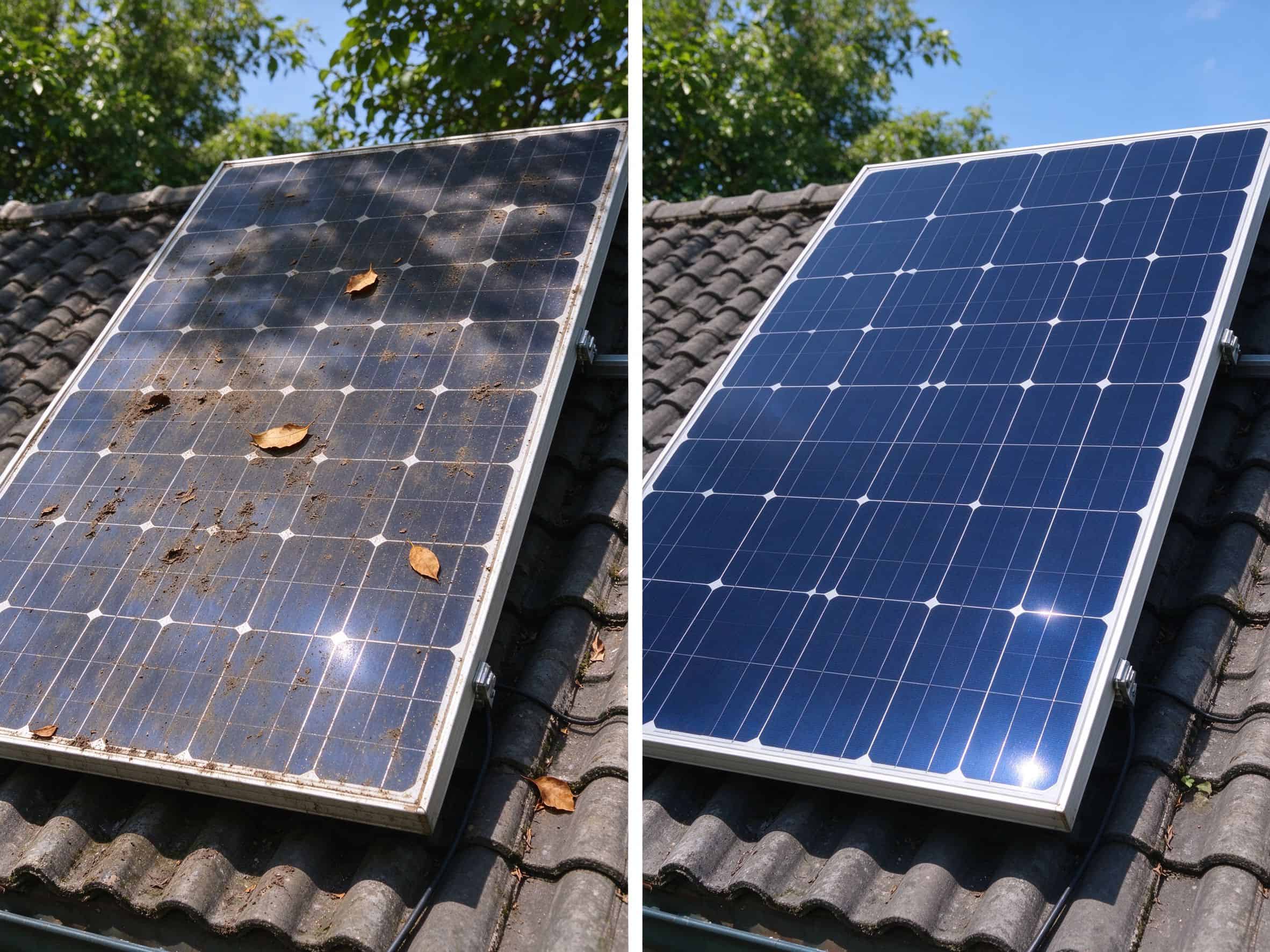
Dust, bird droppings, leaves, and pollen on the glass act like a dimmer switch. A thin film of dust can cut solar panel output by ten to twenty percent before you even notice it. Shade is worse. A single leaf covering one cell can drag down the whole series string, because the cells are wired in series and the string performs at the level of its weakest cell. Temperature works the opposite way: hot panels make less voltage than their rating, cool panels make more. That is why a winter morning often gives a higher Voc than a summer afternoon, even though the total watt-hours are lower.
Every panel has bypass diodes inside the junction box. They let current flow around a shaded cell instead of overheating it. When a diode fails short, the panel produces almost nothing even in full sun. When it fails open, the panel still works but runs hot under shade. If your Voc reads normal but your Isc is far too low, and the glass is clean and unshaded, suspect the bypass diode. At that point, you are looking at a panel replacement, not a cleaning job.
Read the Numbers, Then Fix the Cause
Testing solar panel power output is not a one-time event. Once or twice a year, pull the multimeter out, lay the panel in the sun, and compare Voc and Isc against the spec sheet. The test takes fifteen minutes. It tells you whether to climb up with a brush, trim the tree branch, order a replacement diode, or simply relax and enjoy the power you already have. Clean the glass, clear the shade, and keep an eye on the temperature. Do that, and your panels will keep putting out close to their rated wattage for the twenty-five years they are warrantied to last.