
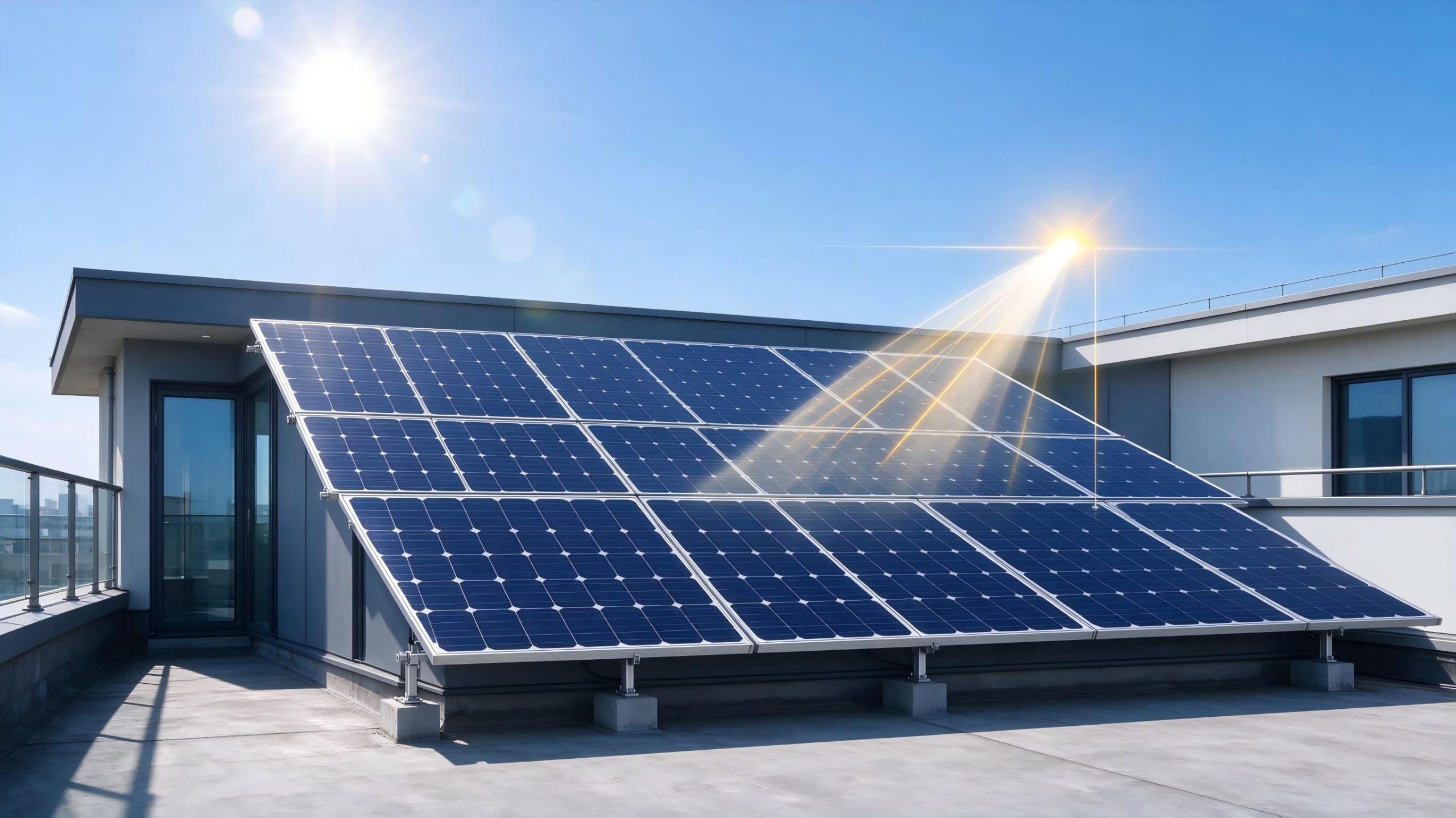
Solar panel efficiency is the percentage of sunlight a panel turns into DC electricity. A typical residential module today sits around 20 to 22 percent. That number is measured under standard test conditions, so it does not tell the whole story on your roof. Real output also moves with temperature, shading, dirt, orientation, and the rest of the system. Higher efficiency matters most when roof space is tight. On a large roof, a cheaper panel in a bigger array often wins on cost per kilowatt-hour. Efficiency, rated wattage, and energy output are three different numbers. Mix them up, and you overpay or under-size the system.
What Is Solar Panel Efficiency?
Understanding solar panel efficiency starts with one simple ratio. The panel catches sunlight. A fraction of that light becomes DC electricity. The rest becomes heat or passes through the silicon unchanged. That fraction, expressed as a percentage, is the panel efficiency.
If a panel receives 1,000 watts of sunlight over its surface area and delivers 200 watts of electricity, its efficiency is 20 percent. The other 800 watts does not disappear. It warms the panel or reflects off the glass. Higher efficiency means more electricity from the same amount of sunlight and the same roof area. It does not mean the panel captures a larger share of the sky. It means it uses that share more cleverly.
How Is Solar Panel Efficiency Calculated?
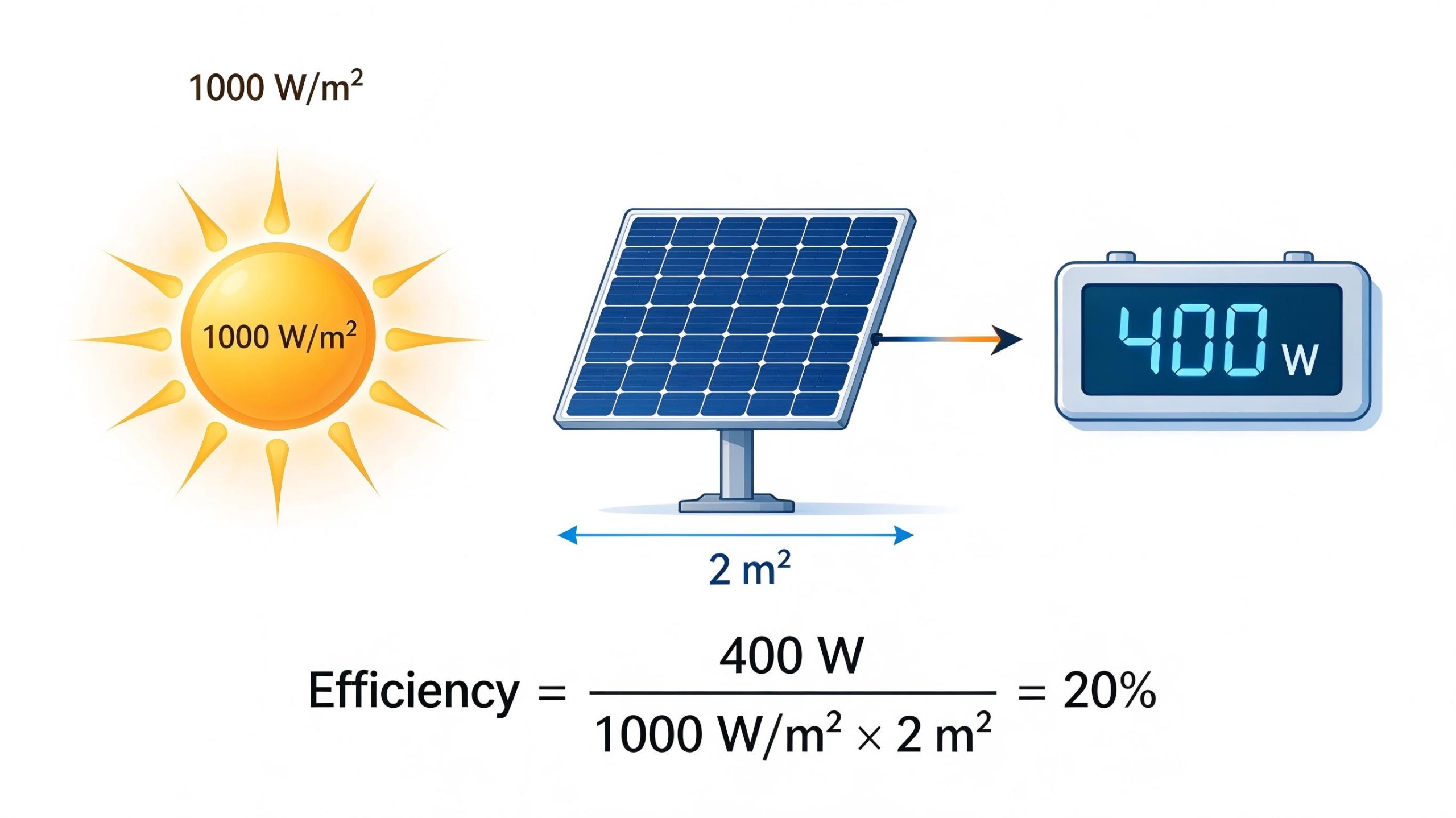
The calculation is a ratio. Divide the electrical power output by the incident solar power, then multiply by 100.
Efficiency = (Electrical Power Output / Incident Solar Power) × 100%
Under Standard Test Conditions, irradiance is 1,000 W per square meter, cell temperature is 25 degrees Celsius, and the light spectrum matches AM 1.5. Worked example. A panel with an area of 2 square meters produces 400 watts under STC. Incident power is 1,000 W/m² × 2 m² = 2,000 W. Efficiency is 400 / 2,000 = 20 percent. This is a worked example, not a field measurement. Real panels carry a plus or minus tolerance on the rated wattage, and real roofs rarely sit at 25 degrees.
What Is the Difference Between Efficiency, Wattage, and Energy Output?
Three numbers get confused constantly.
- Efficiency is a percentage.
- Rated wattage is the power the panel produces under STC.
- Energy output in kilowatt-hours is what the panel actually delivers over a day, a month, or a year.
A 400W panel at 20 per cent efficiency and a 420W panel at 21 per cent efficiency sit on the same roof size. The 420W panel makes more watts under STC. Over a cloudy January, the difference in kilowatt-hours depends on weather and orientation, not just the spec sheet. Efficiency compares panels of different sizes. Wattage tells you the nameplate power. Kilowatt-hours tell you the bill impact.
What Factors Affect Solar Panel Efficiency?
In laboratory testing, a photovoltaic module has a measured conversion efficiency. In the field, that number moves for two sets of reasons. Some come from the cell itself. Others come from the roof, the weather, and the cleaning schedule.
Solar Cell Technology and Panel Design
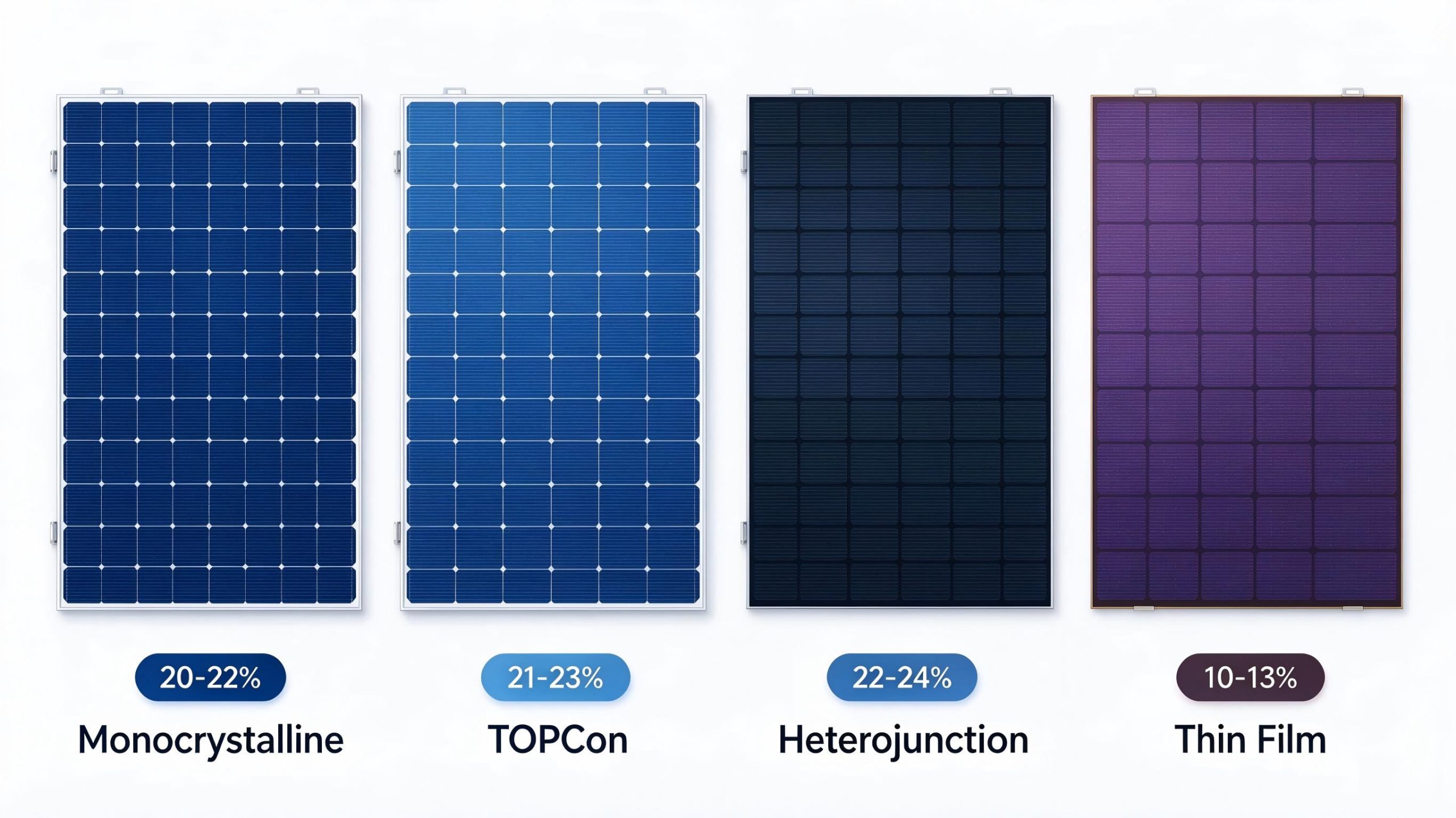
Monocrystalline silicon remains widely used in residential solar modules. TOPCon and heterojunction (HJT) are advanced crystalline-silicon cell architectures that use different passivation and contact structures to reduce recombination losses. They can achieve higher efficiencies than some older cell designs, although the improvement depends on the specific product. Module-level features also matter. Anti-reflective coatings can reduce optical losses, while half-cut cell designs can reduce resistive losses and improve performance under certain operating conditions. Other construction materials, including backsheets and encapsulants, primarily influence insulation, durability, and resistance to environmental stress. Check the exact module datasheet to understand what each design feature delivers.
Temperature and Sunlight Conditions
Crystalline silicon modules generally produce less power as their cell temperature rises. The size of the reduction depends on the module’s power temperature coefficient, which is listed in the manufacturer’s datasheet. For illustration, a module with a power temperature coefficient of minus 0.35% per degree Celsius would experience an estimated 12.25% reduction in power at a cell temperature of 60 degrees compared with 25 degrees, assuming a linear temperature relationship and otherwise comparable conditions. This is a temperature-related estimate, not a prediction of total daily energy production. At an irradiance of 400 W per square meter, a panel will generally produce substantially less power than its STC rating. Because current, voltage, temperature, and inverter behavior all affect output, the actual power will not always equal exactly 40% of rated power.
Shading, Dirt, and Panel Orientation
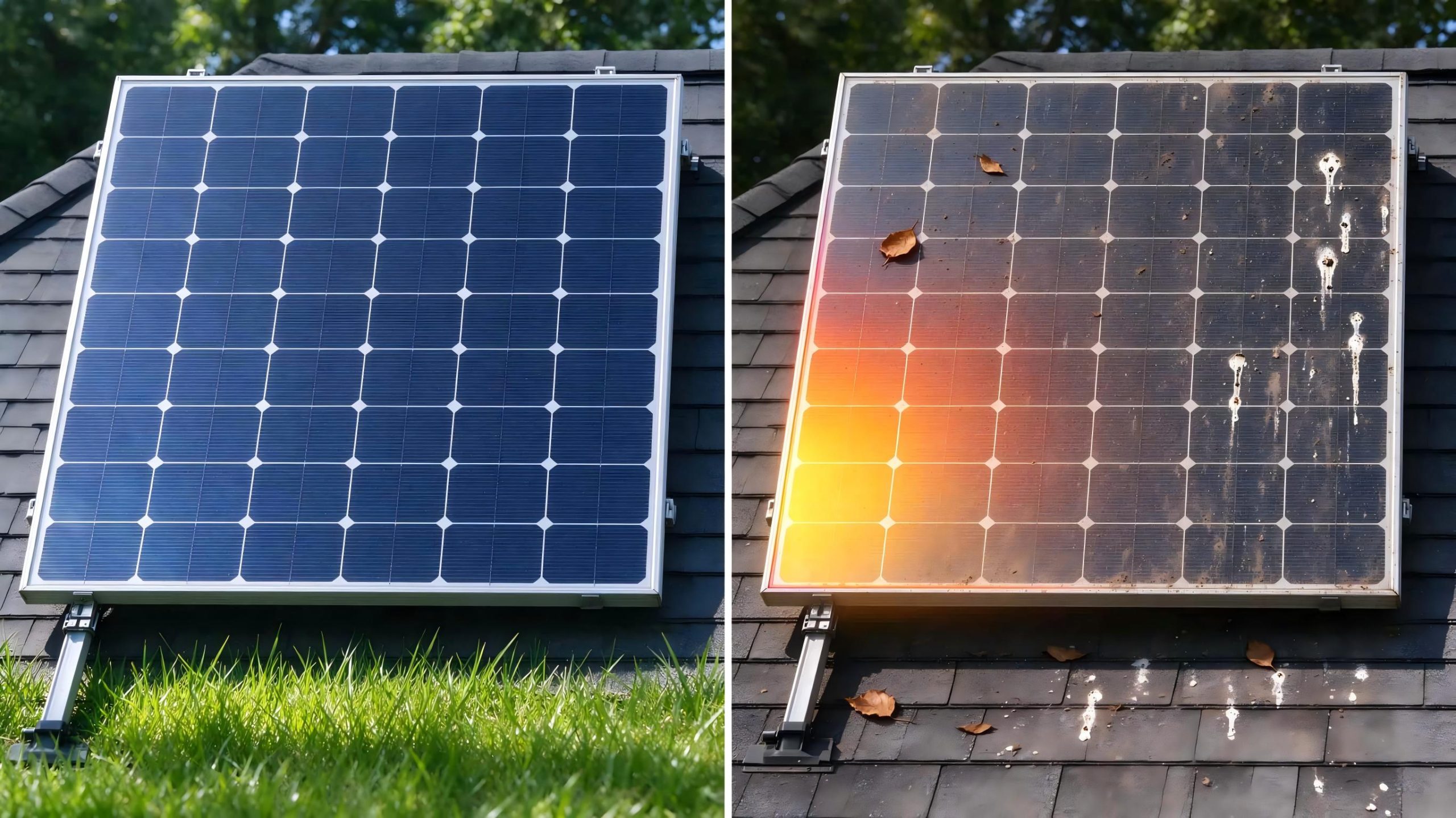
A shadow on one cell can drag down a whole substring. Bypass diodes limit the loss, but they do not eliminate it. Dust, pollen, bird droppings, and snow cover reduce the light that reaches the silicon. The resulting energy loss varies with local weather, nearby vegetation, pollution, panel tilt, and cleaning practices. Tilt and orientation set how much sunlight hits the glass across the day. A panel facing east on a shallow roof catches the morning sun and misses the afternoon peak. These factors change real output without changing the panel’s STC efficiency number on the label. Rather than assuming a fixed loss percentage for an entire climate zone, use site-specific performance data where available and follow the manufacturer’s cleaning instructions.
Aging and Long-Term Performance
Solar modules gradually lose some of their power output as they age, but the rate varies with module design, environmental conditions, and measurement methods. A widely cited review of nearly 2,000 reported degradation rates by Jordan and Kurtz found a median value of around 0.5% per year. A separate U.S. analysis of photovoltaic system performance, based on nearly 19,000 inverters, reported a median annual performance loss of about 0.75%. These figures describe different datasets and should not be treated as interchangeable guarantees for an individual panel. When comparing products, check the manufacturer’s product warranty and linear power warranty. Review the guaranteed output over time, including any first-year degradation allowance and subsequent annual limits, instead of assuming every panel follows the same rate.
How Efficient Are Solar Panels?
Buyers often want a quick answer about the efficiency of typical solar panels. The honest answer is a range, and the range depends on whether you are comparing a residential module, a thin-film commercial product, or a laboratory cell.
Berkeley Lab’s 2026 U.S. Distributed Solar and Storage Data Update reports median module efficiencies of approximately 21.3% for residential installations and 21.4% for non-residential installations in 2025. These figures describe installed modules in the U.S. distributed solar market, not the highest efficiency available from manufacturers or a universal average for all solar panels. Individual products vary by design, dimensions, and rated power. When comparing specific panels, check the manufacturer’s datasheet and the applicable test conditions rather than relying on a market median.
How Do Different Solar Panel Technologies Compare?
The table below summarises what to compare across cell architectures and material classes. Treat the ranges as approximate commercial bands, not fixed specs. Always verify the exact model datasheet.
|
Technology class
|
Typical commercial module efficiency
|
What to compare on the datasheet
|
Selection note
|
|---|---|---|---|
|
Conventional monocrystalline silicon, such as PERC
|
Roughly 20 to 22%
|
Efficiency, temperature coefficient, dimensions, 25-year linear warranty
|
Baseline residential option
|
|
TOPCon, n-type crystalline silicon
|
Roughly 21 to 23%
|
Efficiency, temperature coefficient, price per watt
|
Higher-output residential bids
|
|
HJT heterojunction silicon
|
Roughly 22 to 24%
|
Efficiency, temperature coefficient, warranty terms, installed cost
|
Compare against system price and roof geometry
|
|
Thin-film technologies, such as CdTe and CIGS
|
Varies by product; some commercial modules reach close to 19%
|
Temperature response, spectral response, form factor, specific model datasheet
|
Commercial and specialized installations
|
Commercial Panel Efficiency vs. Laboratory Records
The National Laboratory of the Rockies (NLR), formerly NREL, maintains a chart of verified research-cell efficiency records across different photovoltaic technologies. The chart includes crystalline silicon cells above 26% efficiency and multi-junction concentrator cells above 47%. These are laboratory research-cell records, not typical commercial module ratings. Compare records by technology category and test conditions, and consult the current chart for the latest confirmed values. Cell efficiency is not module efficiency. Module efficiency is always lower because the frame, the busbars, and the gaps between cells lose a few points.
How to Choose and Get the Most from Efficient Solar Panels
Understanding module efficiency helps you decide whether higher-efficiency panels justify their cost. Higher efficiency costs more per panel. It also fits more watts on the same roof. Whether that trade is worth it depends on one question: do you have room?
Higher efficiency matters most when roof space is tight. A small south-facing roof that fits 18 panels gains more from a 22 per cent module than from a 19 per cent module, because you cannot simply add another row. On a large barn roof with empty space, a cheaper 19 per cent panel in a bigger array can deliver the same kilowatt-hours at a lower cost. Efficiency is a space problem first, a performance problem second.
How to Compare Efficiency, Wattage, and Cost
Do not buy on the efficiency number alone. Compare the efficiency, the rated wattage, the physical dimensions, the temperature coefficient, the long-term power warranty, and the installed price per watt. A panel with 21 per cent efficiency but a weak temperature coefficient loses ground on hot roofs. A panel with 22 per cent efficiency but a 10-year product warranty may cost more over 25 years than a 20 per cent panel with a 25-year warranty. This site lists the residential panels, batteries, and charge controllers you can size together. And the panel maintenance guide covers the upkeep side.
How to Maximise Real-World Solar Energy Production
The U.S. Department of Energy separates module conversion efficiency from system energy output. The second one depends on installation. To improve real-world production, plan the array’s orientation and tilt around the site’s location, roof geometry, shading, and expected energy needs. Inspect panels periodically for visible debris or damage, and clean them when local conditions and the manufacturer’s guidance justify it. Follow the system’s maintenance instructions after severe weather, and leave electrical connections, grounding components, and repairs to qualified personnel. A 21 per cent panel poorly installed with a shaded corner underproduces a 19 per cent panel that faces true south, stays clean, and runs cool. Efficiency is the starting point. Installation is the multiplier.
The Bottom Line on Solar Panel Efficiency
Solar panel efficiency measures how effectively a module converts sunlight into electricity under specified test conditions. Cell technology determines the rated efficiency, while temperature, shading, dirt, orientation, and system design affect real-world energy production. Ageing can also reduce a module’s measured power output over time. When comparing quotes, evaluate efficiency alongside rated wattage, roof area, temperature coefficient, long-term warranty, and total installed cost. The best choice is not necessarily the panel with the highest efficiency percentage, but the system that delivers suitable energy production for your roof, budget, and needs.