
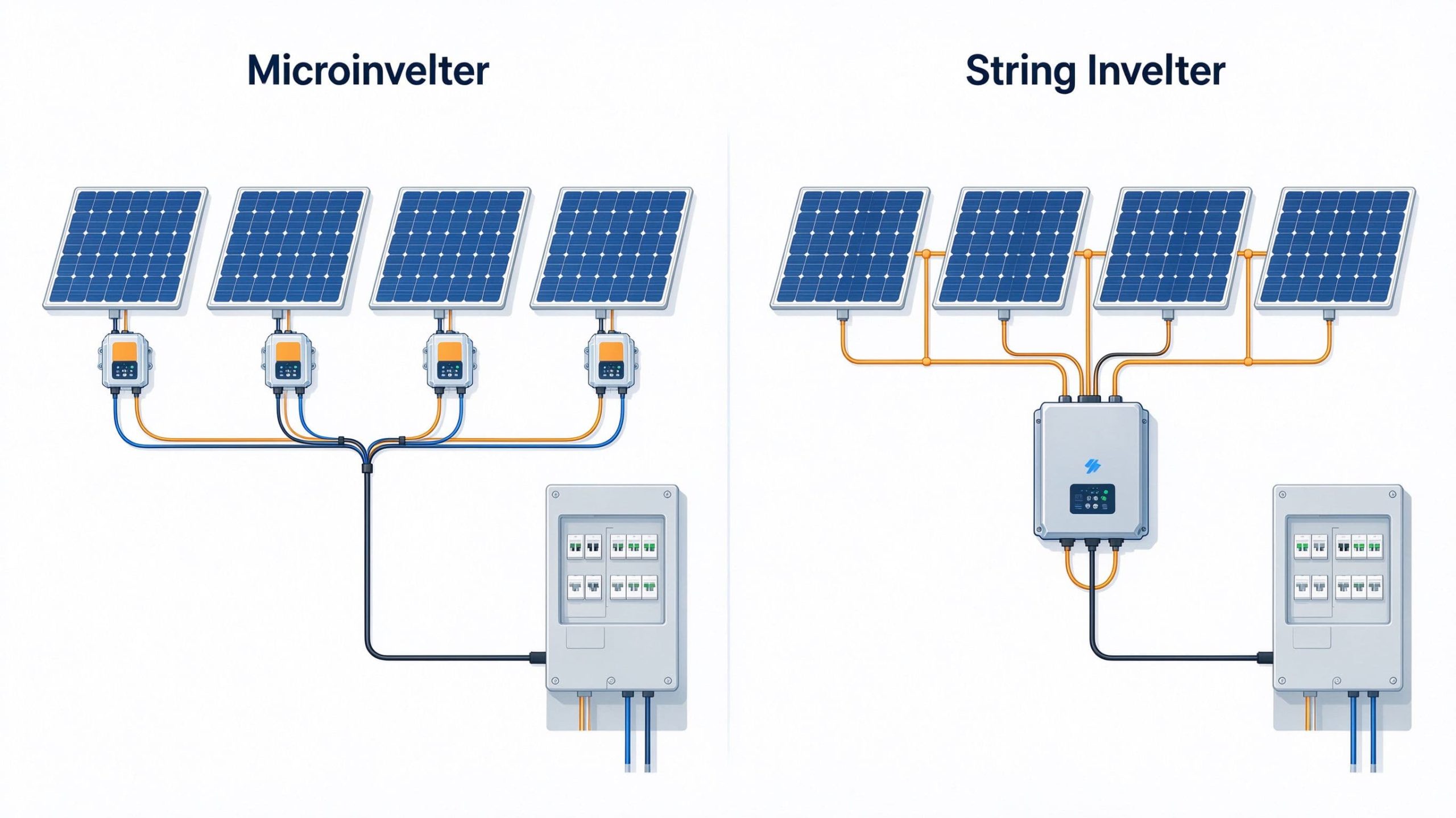
Microinverter vs. string inverter comes down to one question: where does the DC-to-AC conversion happen? A microinverter sits behind each panel and converts on the roof. A string inverter hangs on the wall and converts the combined DC from a whole row of panels. Both feed AC power to your home or the grid. They differ in shading tolerance, panel-level monitoring, upfront cost, and how a single failure takes the system down. The right choice depends on your roof, your shade, your budget, and whether you plan to add batteries later.
What Is the Difference Between Microinverter vs String Inverter Work?
The difference between microinverters and string inverters comes down to where each piece of hardware sits in the circuit. One breaks the conversion into small units on the roof. The other centralizes it in a single box on the wall.
A microinverter mounts on the racking behind each panel. Each panel feeds its own microinverter with DC. The microinverter converts that panel’s DC to AC right there. Because each panel has its own conversion stage, it can run its own maximum power point tracking. When one panel is shaded, the others keep running at their own optimum. The AC from every microinverter joins on a common AC trunk that runs to the home electrical panel. Most microinverter systems report panel-level production through a portal.
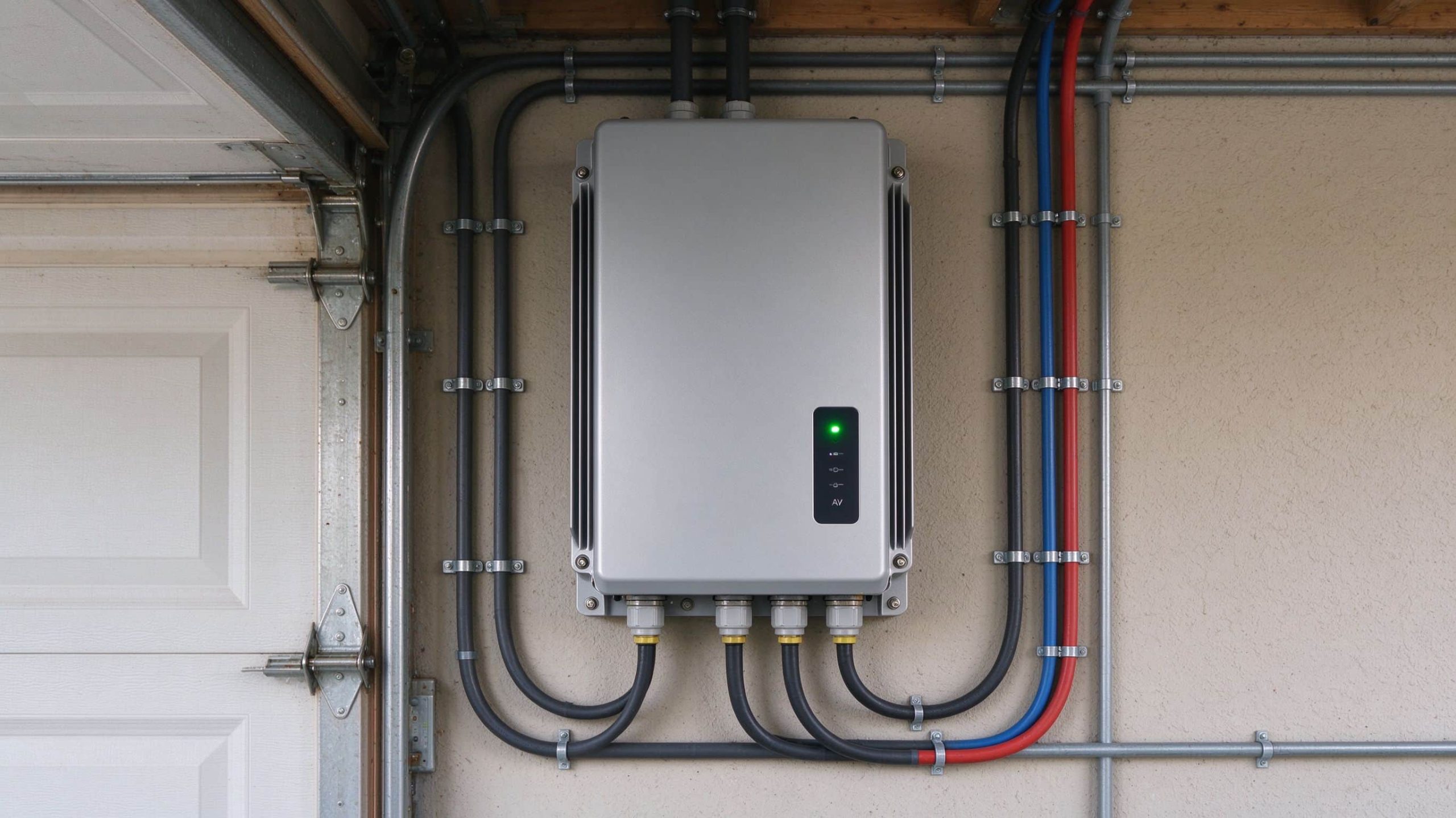
A string inverter sits on a garage wall or inside a utility room. Multiple panels wire in series to form a string, sometimes two or more strings. The string inverter takes the combined DC and converts it to AC in one box. String inverters are simple to install and easy to reach for service. A clean, unshaded roof on a single azimuth runs a string inverter near its design point. The trade-off is that every panel in a string shares the same current. One shaded or underperforming panel drags the whole string down, unless bypass diodes or optimizers reshape the behavior.
What Is the Difference Between a String Inverter and a Power Optimizer System?
A power optimizer is neither a microinverter nor a plain string inverter. It mounts behind each panel and does DC-to-DC conversion. It conditions the panel output and sends DC down to a central string inverter, which still handles the DC-to-AC conversion. The optimizer approach gives you panel-level maximum power point tracking, but the AC conversion stays in one box. People shopping often mix all three up. The difference matters for monitoring, for replacement, and for what a failure actually takes offline.
Microinverter vs String Inverter Key Differences
Micro vs string solar inverters trade one set of advantages for another. The table below is the short version.
|
Factor
|
Microinverter
|
String inverter
|
|---|---|---|
|
Power conversion
|
Per panel, on the roof
|
Centralized, one box for the string
|
|
Partial shading
|
One panel does not drag down the rest
|
Whole string affected unless bypass diodes or optimizers are used
|
|
Mixed roof orientations
|
Flexible, each panel tracks independently
|
Needs separate strings or optimizers
|
|
Monitoring
|
Typically panel-level
|
String or system-level, depends on model
|
|
Upfront cost
|
Higher per watt
|
Lower per watt
|
|
Service access
|
Roof-mounted, harder to reach
|
Wall-mounted, easy to reach
|
|
Expansion
|
Add panels with matched microinverters
|
Check inverter capacity and string design
|
Which Inverter Performs Better in Shaded Conditions?
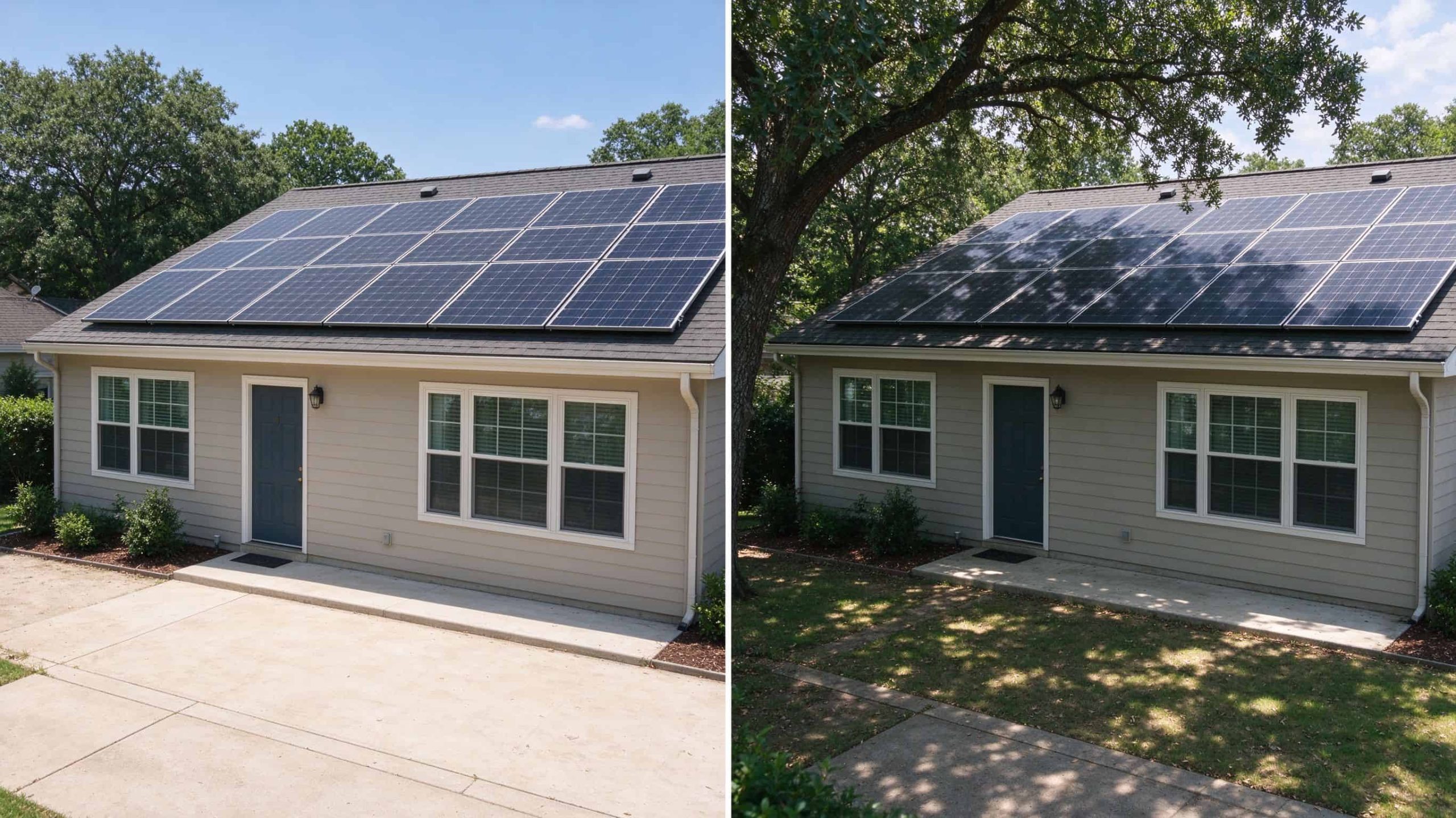
Microinverters can reduce the impact of partial shading because each panel has its own maximum power point tracking and DC-to-AC conversion. If one panel is shaded, the other panels can generally continue operating independently, although the shaded panel still loses production. A string inverter can also handle some shading through module bypass diodes and careful string design. Systems with DC power optimizers can further reduce mismatch losses by managing each panel output individually. The production advantage of microinverters depends on the shade pattern, array layout, equipment, and operating conditions. Ask installers to model annual energy production for your actual roof before deciding whether the added cost is justified.
Which Inverter Is More Efficient?
Do not choose an inverter based on a single efficiency percentage alone. Both modern microinverters and string inverters can achieve high conversion efficiency, but actual performance depends on the model, operating conditions, and system design. On a simple, unshaded roof, the production difference between well-designed systems may be small, making installed cost and service requirements important factors. On roofs with partial shading or multiple orientations, module-level power electronics may recover some otherwise-lost production. Compare the manufacturer efficiency specifications and, more importantly, the estimated annual energy production for your specific roof under each proposed system design.
Which Inverter Offers Better Monitoring and Reliability?
Microinverters report per-panel data, so a faulty panel jumps out in the app. String inverters report per string. A problem on one panel inside a string shows up as a string-level underperformance, and the technician climbs up to find it. Reliability cuts both ways. Microinverters are sealed on the roof and have no moving parts, but there are many of them, and failure requires roof access. A string inverter is one box on a wall. It is easy to service, but when it fails, the whole string or the whole system goes down until it is fixed. Check the warranty term and the expected replacement cost before you assume one is more reliable than the other.
Micro inverter vs String Inverter Cost, Maintenance, and Long-Term Value
The microinverter versus string inverter comparison moves from performance to dollars once the roof is mapped. Upfront cost, service access, warranty, and battery compatibility all shape the bill.
String inverters usually cost less upfront. One box replaces dozens of roof units. A typical residential string inverter lands at a lower per-watt cost than an equivalent microinverter system. Microinverters add hardware behind every panel, and that hardware shows up in the installed price. The right comparison is the total system quote, not the inverter line item. A string inverter with power optimizers costs more than a bare string inverter but less than full microinverters in many cases. Get three quotes on the same roof before deciding on price alone.
Maintenance, Repairs, and Warranty
A string inverter is usually easier to access for service because it is mounted on a wall or in a designated equipment area. Replacing a rooftop microinverter may require a technician to access and remove the associated panel. The impact of a failure also differs. A failed microinverter generally stops production from the associated panel, while a failed central string inverter can interrupt production for the array connected to it. Warranty terms vary by manufacturer, model, and market. Compare the standard warranty period, extension options, parts coverage, labor coverage, and any costs associated with removing and reinstalling equipment. Don’t assume either architecture is automatically more reliable without evidence for the specific products being compared.
Which Is Better for Future Expansion and Battery Storage?
Microinverter systems generally offer panel-level production monitoring and can support modular expansion. However, adding panels still requires checking the AC circuit capacity, electrical requirements, and compatibility of the existing monitoring equipment. String inverter systems may offer DC-coupled or AC-coupled storage options, depending on the inverter and battery architecture. Microinverter systems commonly use AC-coupled storage, but battery backup requires compatible equipment and a system designed to operate safely during a grid outage. Before choosing either architecture, confirm the exact inverter, battery, backup hardware, and monitoring components are compatible. Ask the installer to document the supported configuration rather than relying on the product category alone.
Microinverter vs String Inverter: Which Should You Choose?
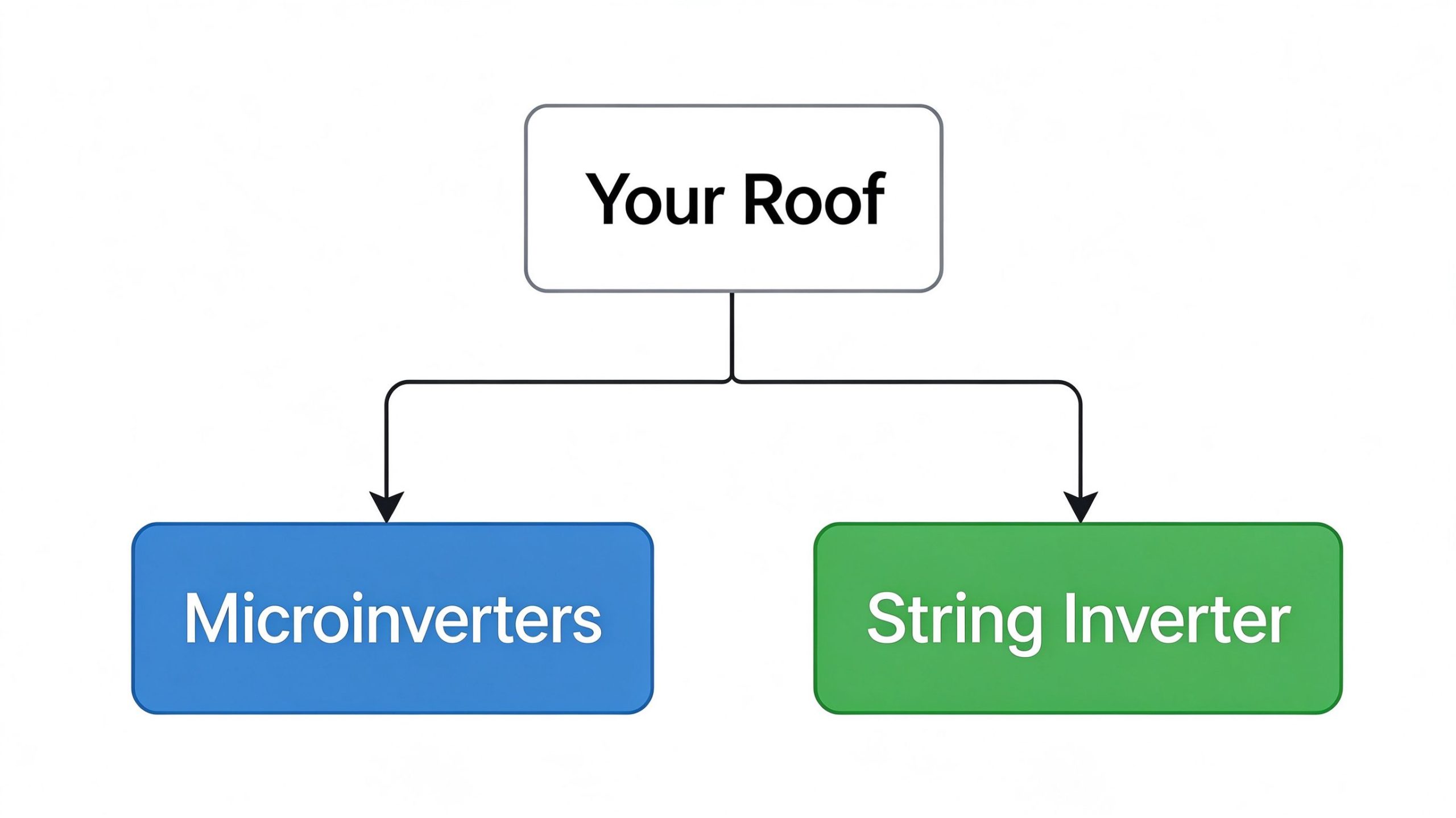
The solar microinverter vs string inverter comparison ends with your roof on paper. The decision below is a starting point, not a final answer. A local installer running a production estimate for your address closes the gap.
When Should You Choose Microinverter vs String Inverter?
Microinverters often fit roofs that are not simple. Trees cast morning shade. The roof has a chimney, a dormer, or a vent stack. Panels sit on two azimuths, such as a south and an east slope. You want to open the app and see per-panel production. You plan to add panels one or two at a time over the next decade. In these cases, module-level power electronics may recover energy that a string system would lose. Ask for an annual production estimate on your actual roof before assuming the extra cost is justified.
String inverters often fit clean roofs. Single south-facing slope, no trees, no obstructions. Budget matters more than per-panel monitoring. You want one box on a wall a technician can reach without a ladder to the roof. You plan to pair the system with a specific hybrid inverter and battery that is only offered in a string architecture. In these cases, a string inverter with optional power optimizers may deliver competitive energy at a lower installed cost, depending on the specific products and project quotes.
How to Make the Final Decision
Before signing a proposal, ask installers to evaluate the roof shading, orientations, and available panel area. Request annual energy estimates for the proposed microinverter and string inverter configurations, including any power optimizers. Compare the total installed price, expected energy production, standard and extended warranties, service costs, and battery compatibility. The best choice is the system that offers the most suitable balance of lifetime energy production, upfront cost, maintenance requirements, and future flexibility for your home. The table below is a starting point.
|
Your situation
|
Starting point
|
|---|---|
|
Simple unshaded roof, tight budget
|
Start with a string inverter
|
|
Shaded, chimneys, mixed orientations
|
Start with microinverters
|
|
Want per-panel production data
|
Microinverters, or string plus optimizers
|
|
Planning battery backup
|
Compare the specific hybrid inverter and battery
|
|
Large system or phased expansion
|
Model capacity, architecture, and lifetime cost together
|
The Bottom Line on Microinverter vs String Inverter
Both architectures can deliver a reliable solar system. Microinverters tend to fit complex roofs, partial shade, and panel-level monitoring. String inverters tend to offer lower upfront cost, easier service access, and a simpler fit for unshaded single-plane roofs. The right answer is not the higher-tech box. It is the architecture that offers the best balance of lifetime energy production, installed cost, warranty coverage, and battery compatibility for your specific roof. Ask each installer for an annual production estimate for your address, read the warranty fine print, and then decide.