
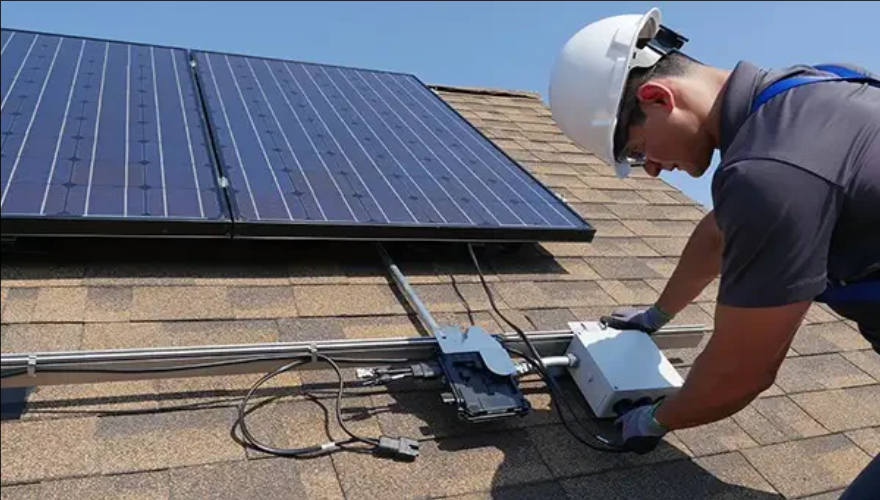
A solar microinverter is a solar device that operates directly at the solar panel, converting direct current (DC) to grid-compatible alternating current (AC) at the source. Typically installed on the back of each solar panel, it is highly efficient. However, the relative efficiency of a microinverter ultimately depends on the specific conditions of the solar power plant and its location.
Its core function is to combine a power conversion unit with intelligent control. It continuously analyzes the electrical output of individual solar panels, optimizes performance under changing environmental conditions, and synchronizes the generated AC with the grid. This solution eliminates many limitations inherent in centralized inverter systems, allowing each solar panel to operate independently at maximum efficiency.
Solar Microinverter Architecture
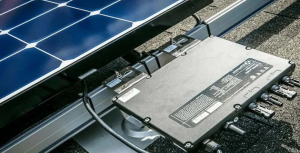
The architecture of a solar microinverter integrates multiple power electronic stages into a compact, weatherproof housing. Each unit is installed directly behind or near the solar panel, enabling it to process energy at the panel level.
Inside the microinverter, the first critical stage is the DC input regulation circuit. This stage stabilizes the fluctuating DC voltage generated by the solar panel, which varies with sunlight intensity, temperature, and shading. Afterward, power is fed into a high-frequency DC-DC converter, where the voltage is regulated to its optimal operating range. This process is strictly controlled to minimize energy loss while ensuring electrical safety.
Following voltage regulation, the inverter employs a DC-AC conversion stage using advanced semiconductor switches. These components rapidly modulate the electrical signal to generate a pure sinusoidal AC waveform that matches the grid voltage, frequency, and phase. An integrated digital controller monitors each step, ensuring precise synchronization with grid conditions. This tightly coupled design enables the solar microinverter to output stable, high-quality power directly from each solar module.
Performing Maximum Power Point Tracking
The solar microinverter can perform Maximum Power Point Tracking (MPPT) at the module level. Solar panels do not operate at a fixed point; instead, their optimal output varies continuously with irradiance, temperature, and load conditions. Extracting maximum energy requires continuous adjustments.
Each microinverter monitors the current-voltage characteristics of its connected modules in real time. It uses built-in algorithms to identify the precise operating point where power output is maximized. Microinverters can be independently adjusted to ensure each component performs optimally, whereas centralized solar inverters require compromises between multiple components.
This localized MPPT (Maximum Power Placement) process is particularly important in practical installations where shading, clutter, or orientation differences are unavoidable. If the light intensity of one component decreases, it only affects its output. Neighboring components continue to operate without interruption. Therefore, the entire system maintains a high energy output throughout the day.
Power Conversion and Grid Synchronization
Once optimal DC power is established, solar microinverters focus on precise power conversion and grid synchronization. The inverter uses pulse-width modulation (PWM) technology to convert DC power into a high-quality AC waveform. Built-in sensors continuously measure grid voltage and frequency, enabling the microinverter to synchronize its output within milliseconds.
Safety mechanisms are directly integrated into the conversion process. If grid instability or a power outage is detected, the inverter immediately stops outputting power to prevent reverse feed. This anti-islanding feature effectively protects electrical maintenance workers.
Distributed Inverter Design
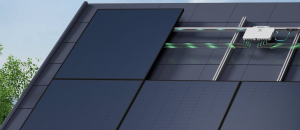
Thermal control plays a crucial role in the long-term reliability of any solar product, including microinverters. Because these devices are installed on rooftops and exposed to harsh environmental conditions, a robust thermal management system is incorporated.
Most microinverters do not rely on active cooling systems, such as fans; instead, they achieve passive cooling through an optimized aluminum casing and an internal layout. Heat-generating components are carefully arranged to reduce thermal stress, while efficient circuitry minimizes energy loss during conversion, extending lifespan.
Furthermore, compared to traditional inverters, microinverters utilize fewer high-failure-rate components. Reduced reliance on large electrolytic capacitors and the use of solid-state electronics improves durability.
Communication, Monitoring, and Control of Solar Microinverters
In addition to power conversion, solar microinverters also function as data-driven control nodes in photovoltaic systems. Integrated communication modules enable each inverter to transmit performance data to a central monitoring platform, maintaining visibility of the entire system during operation.
Panel-level monitoring enables rapid fault detection and accurate diagnosis. Output fluctuations, voltage anomalies, or environmental influences can be identified in real time. It simplifies maintenance and reduces downtime because problems are isolated to specific components rather than the entire string.
The Significance of Using Solar Microinverters
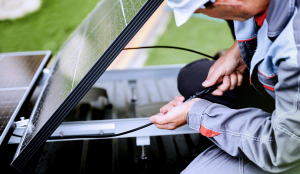
Solar microinverters solve long-standing problems associated with centralized solar inverters. Their operating principle, based on localized maximum power point tracking (MPPT), precise DC-AC conversion, real-time grid synchronization, and intelligent monitoring, delivers significant advantages in efficiency, reliability, and system flexibility.
As solar installations become increasingly diverse and performance requirements rise, microinverter technology offers a future-proof solution. It can naturally adapt to complex rooftops, varying shading, and constantly changing energy demands, while maintaining high safety standards and long-term durability.