
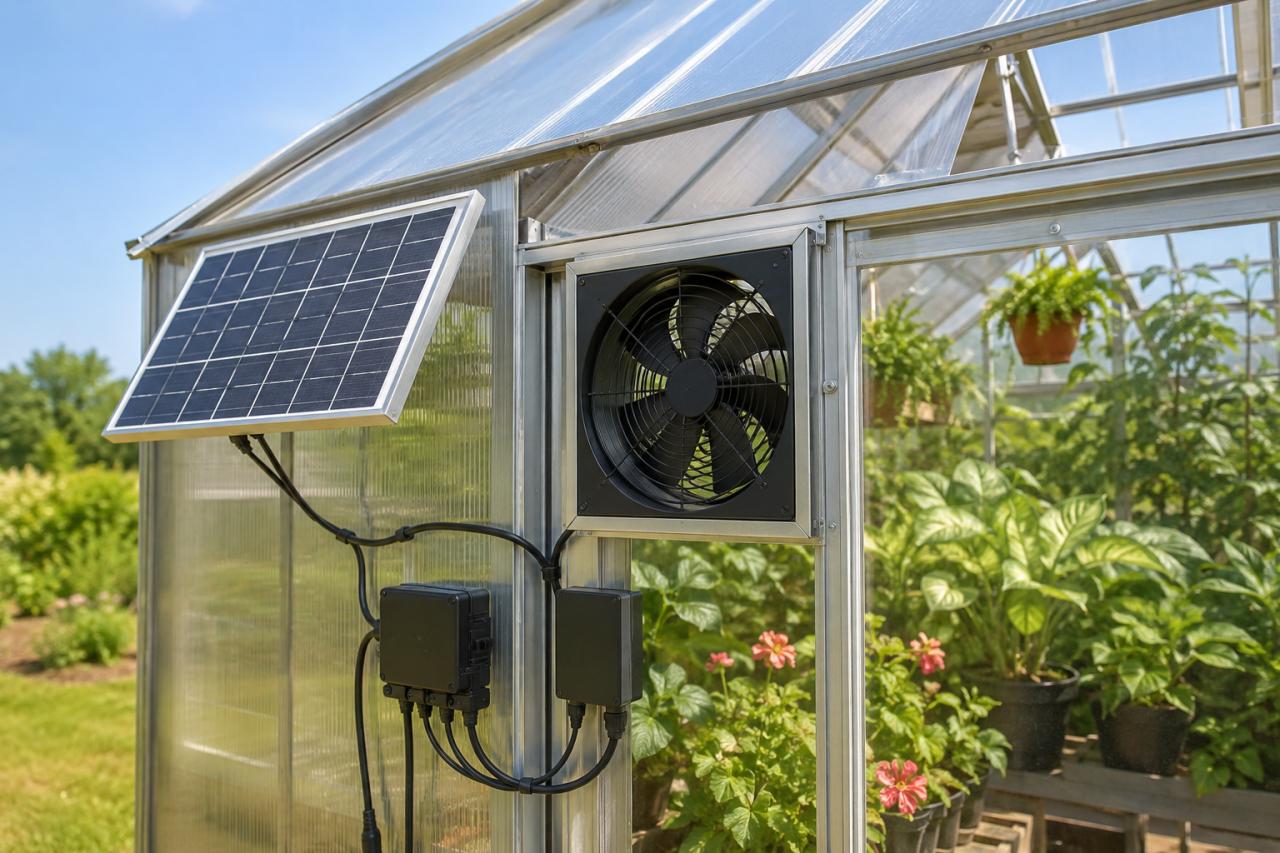
A greenhouse uses sunlight to create a warmer growing environment, but excessive heat and humidity can quickly affect plant growth. During sunny weather, the temperature inside a greenhouse may rise much faster than the outdoor temperature, especially when doors, roof vents, or side vents cannot release enough warm air.
A solar ventilation fan removes trapped air without requiring permanent grid wiring. However, fan diameter alone does not determine whether a system will work. Greenhouse size, airflow, sunlight conditions, solar panel output, intake openings, and operating time must all match.
How a Solar Ventilation Fan Supports Greenhouse Airflow
A solar ventilation fan normally works as an exhaust fan. It pushes hot and humid air out of the greenhouse while drawing cooler outside air through vents, louvres, or open doors.
This process can help:
- Reduce excessive daytime heat
- Remove humid air
- Improve fresh-air exchange
- Support natural roof and side vents
- Reduce hot spots around plants
- Ventilate greenhouses without nearby grid power
An exhaust fan and a circulation fan perform different jobs. An exhaust fan exchanges indoor and outdoor air. A circulation fan only moves air inside the greenhouse.
When trapped heat is the main problem, an exhaust-style solar fan is more suitable. When temperatures are acceptable, but air remains uneven around the plants, additional circulation fans may be useful.
Size a Solar Ventilation Fan for the Greenhouse
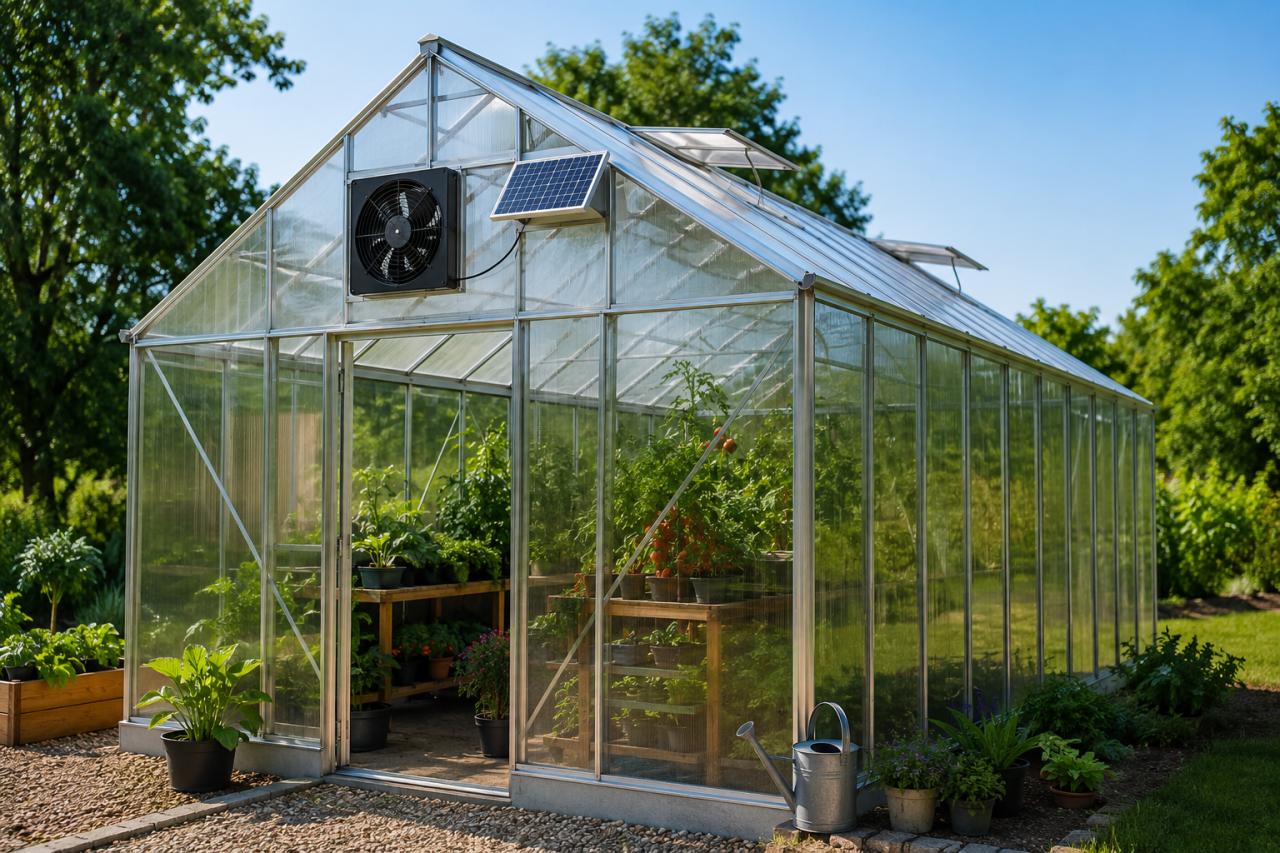
Fan selection should begin with greenhouse volume and airflow requirements. Two fans with the same blade diameter can produce different airflow because of motor power, blade design, fan guards, shutters, and operating voltage.
Calculate Greenhouse Volume
Use this formula:
Length × width × average height = greenhouse volume
For example, a greenhouse measuring 6 metres long, 3 metres wide, and 2.4 metres high has an approximate volume of:
6 × 3 × 2.4 = 43.2 cubic metres
This figure provides a starting point for comparing fan airflow.
Fan performance may be listed in cubic metres per hour or cubic feet per minute. Convert the figures into the same unit before comparing different models.
The University of Massachusetts greenhouse ventilation guidance recommends sizing summer fan ventilation for approximately one greenhouse air-volume exchange per minute. The final requirement may vary with climate, greenhouse height, crop density and shading.
Allow for Airflow Loss
Rated airflow does not always represent real greenhouse performance. Several factors can reduce the actual air volume:
- Insect screens
- Protective fan guards
- Automatic shutters
- Small intake vents
- Long ducts
- Dirty blades
- Weak solar input
- Poor fan placement
Choose a fan with additional airflow capacity rather than selecting a model that only meets the minimum requirement under perfect conditions.
Larger or longer greenhouses may need multiple fans. Several smaller exhaust points can sometimes provide more even ventilation than one fan installed at the far end.
Match the Solar Ventilation Fan With the Solar Panel
The fan motor and solar panel must work within compatible voltage and current ranges. A high-wattage panel does not automatically improve performance when its electrical output does not match the fan or controller.
Check:
- Fan operating voltage
- Fan rated current
- Solar panel operating voltage
- Solar panel wattage
- Controller input range
- Cable connector type
- Maximum cable length
The solar panel should provide enough power to operate the fan during the hours when greenhouse temperatures normally rise.
Direct Solar Operation
A direct solar fan runs when sunlight reaches the panel. Fan speed normally increases when sunlight becomes stronger and decreases during clouds, early morning, or late afternoon.
This arrangement is suitable when the main goal is daytime heat removal. Greenhouses often need the strongest ventilation when solar output reaches its highest level.
Direct solar systems also use fewer components, making installation and maintenance easier.
Battery-Supported Operation
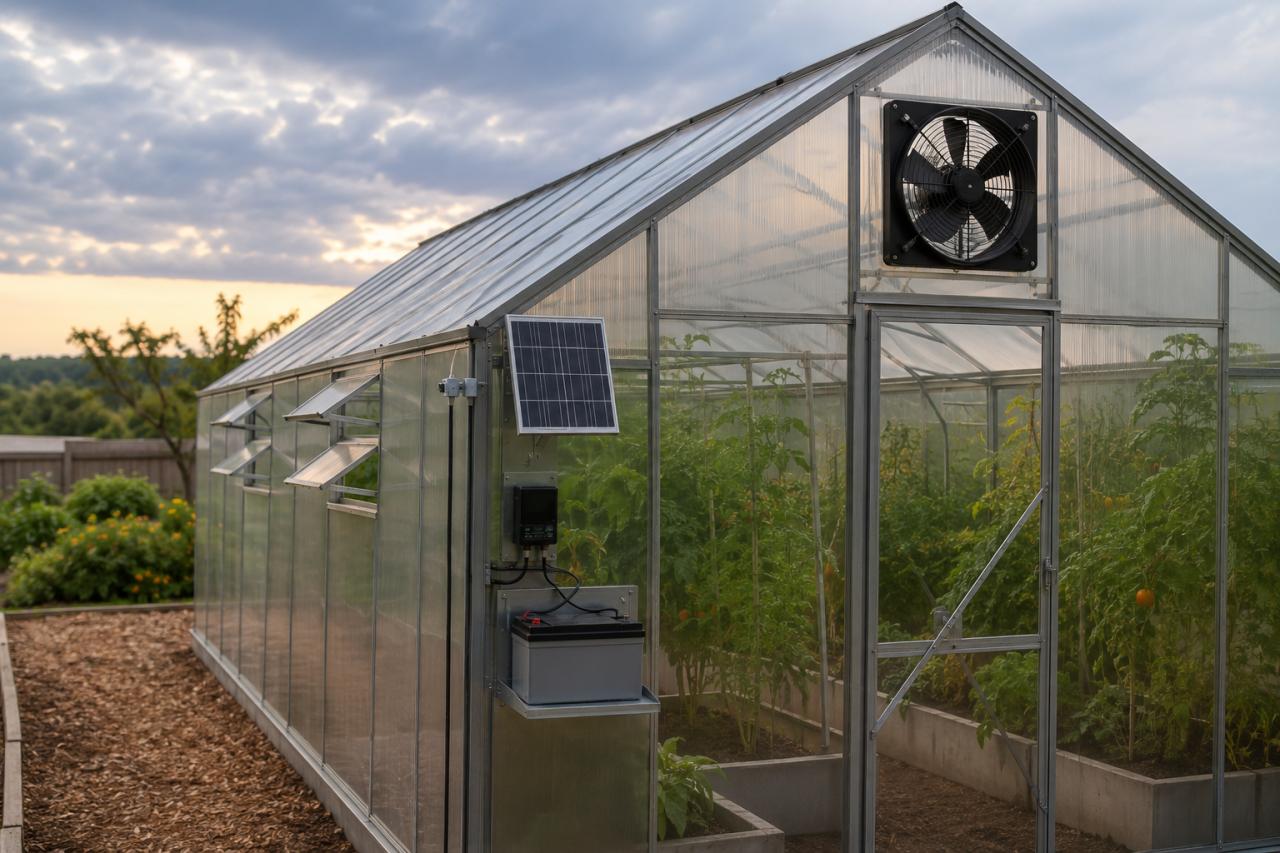
A battery-supported solar ventilation system stores energy for later use. It can keep the fan operating when solar input becomes weak or after sunset.
This setup may be suitable when the greenhouse requires:
- Evening humidity removal
- Stable airflow during cloudy weather
- Thermostat-controlled ventilation
- Extended daily operating time
- Ventilation after irrigation
Battery capacity must match the fan’s power consumption and required operating hours. A small battery may provide only limited runtime, especially when the fan runs continuously.
Install the Solar Ventilation Fan in the Right Position
Fan position affects how efficiently air moves through the greenhouse.
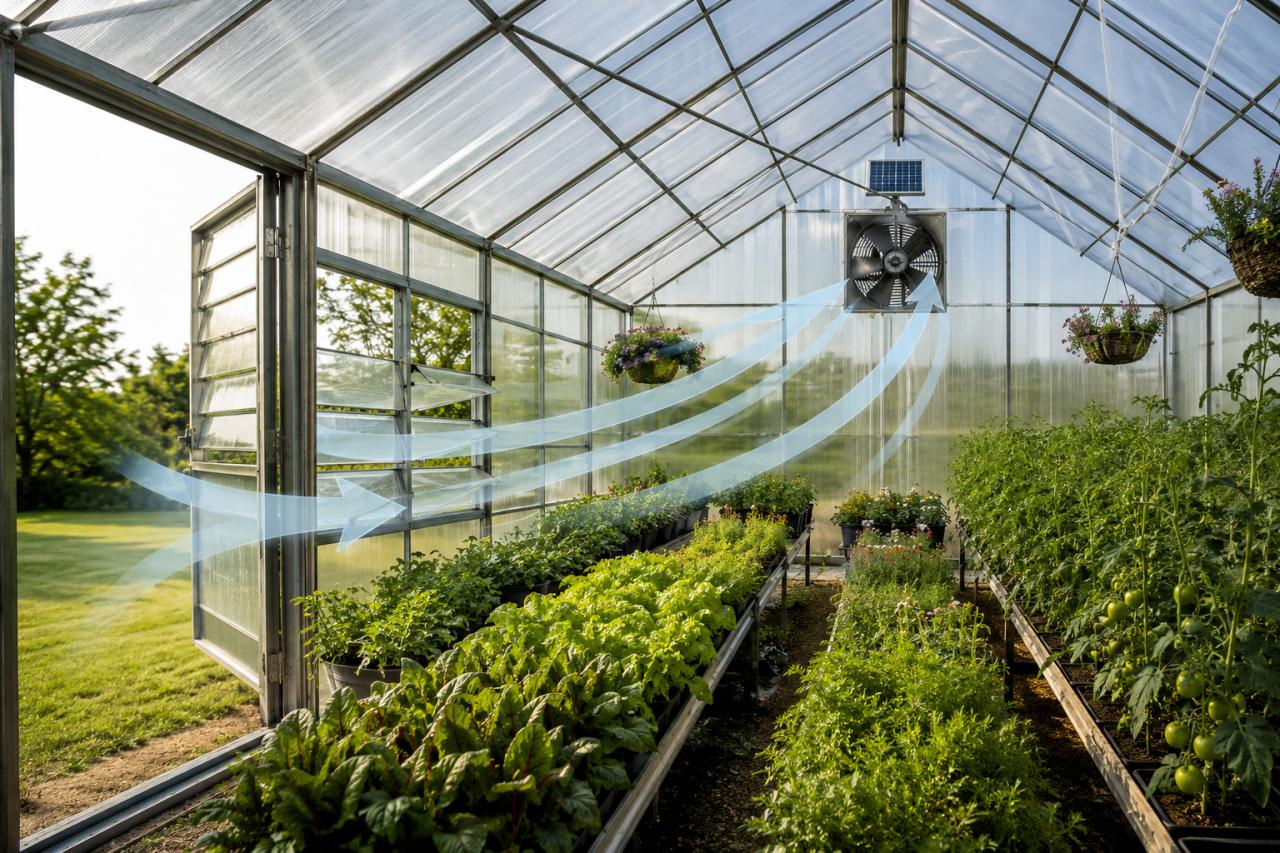
Install the exhaust fan high on an end wall because warm air naturally rises. Place the main intake opening at the opposite end, preferably at a lower position.
This arrangement allows fresh air to travel across the growing space before leaving through the fan.
The intake opening must be large enough. A powerful fan cannot maintain airflow when doors, vents, or louvres restrict incoming air.
Avoid placing the intake directly beside the exhaust fan. Air may follow the shortest route and leave the centre or far side of the greenhouse poorly ventilated.
Long greenhouses may also benefit from internal circulation fans positioned above plant level. These fans help move air toward the exhaust point and reduce warm or humid pockets.
Position the Solar Panel for Reliable Output
The solar panel should receive direct sunlight during the hottest part of the day.
Avoid shade from:
- Greenhouse frames
- Nearby buildings
- Trees
- Roof equipment
- Other solar panels
- Seasonal vegetation
Even partial shade can reduce panel output and slow the fan.
The panel angle should suit the installation location and local sunlight conditions. It should also be mounted securely enough to withstand wind, rain, and normal outdoor exposure.
Keep the cable run as short as practical. Excessively long or undersized cables can create voltage loss and reduce fan speed.
Compare Solar Ventilation Fan Features
Compare products based on operating performance rather than appearance.
Important specifications include:
- Rated airflow
- Fan voltage
- Solar panel wattage
- Direct-solar or battery-supported operation
- Thermostat control
- Adjustable fan speed
- Automatic shutters
- Weather-resistant housing
- Protective fan guards
- Noise rating
- Cable length
- Connector type
- Mounting direction
- Replacement part availability
A thermostat can start the fan only when the greenhouse reaches a selected temperature. This reduces unnecessary operation during cooler periods.
Automatic shutters can help limit rain, insects, and reverse airflow when the fan stops. However, shutters and screens may also reduce airflow, so their effect should be considered during sizing.
Noise may matter when the greenhouse is close to a home, school, shop, hotel, or accommodation area. Check the operating noise rating instead of assuming that a smaller fan will always run quietly.
Choose the Right Solar Ventilation Fan
Choose a direct solar ventilation fan when a small greenhouse mainly needs daytime heat removal during sunny weather. Confirm that the panel receives reliable sunlight and that the intake opening can supply enough fresh air.
Choose a battery-supported system when ventilation must continue during clouds, in the evening, or after irrigation. This option is also more suitable when a thermostat or timer controls fan operation.
For a long or divided greenhouse, use several ventilation points or combine an exhaust fan with circulation fans. Do not rely on one small fan to move air through several separated growing areas.
Before ordering, compare fan and solar equipment through the Solar Shop and confirm the airflow rating, operating voltage, panel output, installation position and required daily runtime.
The selected solar ventilation fan should match the greenhouse volume, required airflow, sunlight conditions, intake design, and operating schedule. A correctly sized system can reduce trapped heat and humidity without adding permanent grid wiring.
FAQ
Can a Solar Ventilation Fan Cool a Greenhouse?
A solar ventilation fan can remove hot indoor air and bring in cooler outside air. It cannot lower the greenhouse temperature below the outdoor temperature. Shade cloth, evaporative cooling, or additional ventilation may still be required in very hot climates.
What Size Solar Fan Does a Greenhouse Need?
The required size depends on greenhouse volume, local climate, intake openings, and the fan’s rated airflow. Calculate the internal volume first, then choose a fan with enough airflow to compensate for screens, shutters, and other restrictions.
Does a Solar Ventilation Fan Work on Cloudy Days?
A direct solar fan may run more slowly during cloudy weather because the panel produces less power. A system with a battery can provide steadier operation when the panel and battery are correctly sized.
Should the Fan Blow Air In or Out?
For greenhouse heat control, the main fan should normally work as an exhaust fan and blow warm air out. Fresh air should enter through vents or louvres on the opposite side.
Does a Solar Greenhouse Fan Need a Battery?
A battery is not necessary when ventilation is only required during sunny daytime conditions. A battery is useful when the fan must operate during cloudy conditions, in the evening, after irrigation, or under thermostat control.