
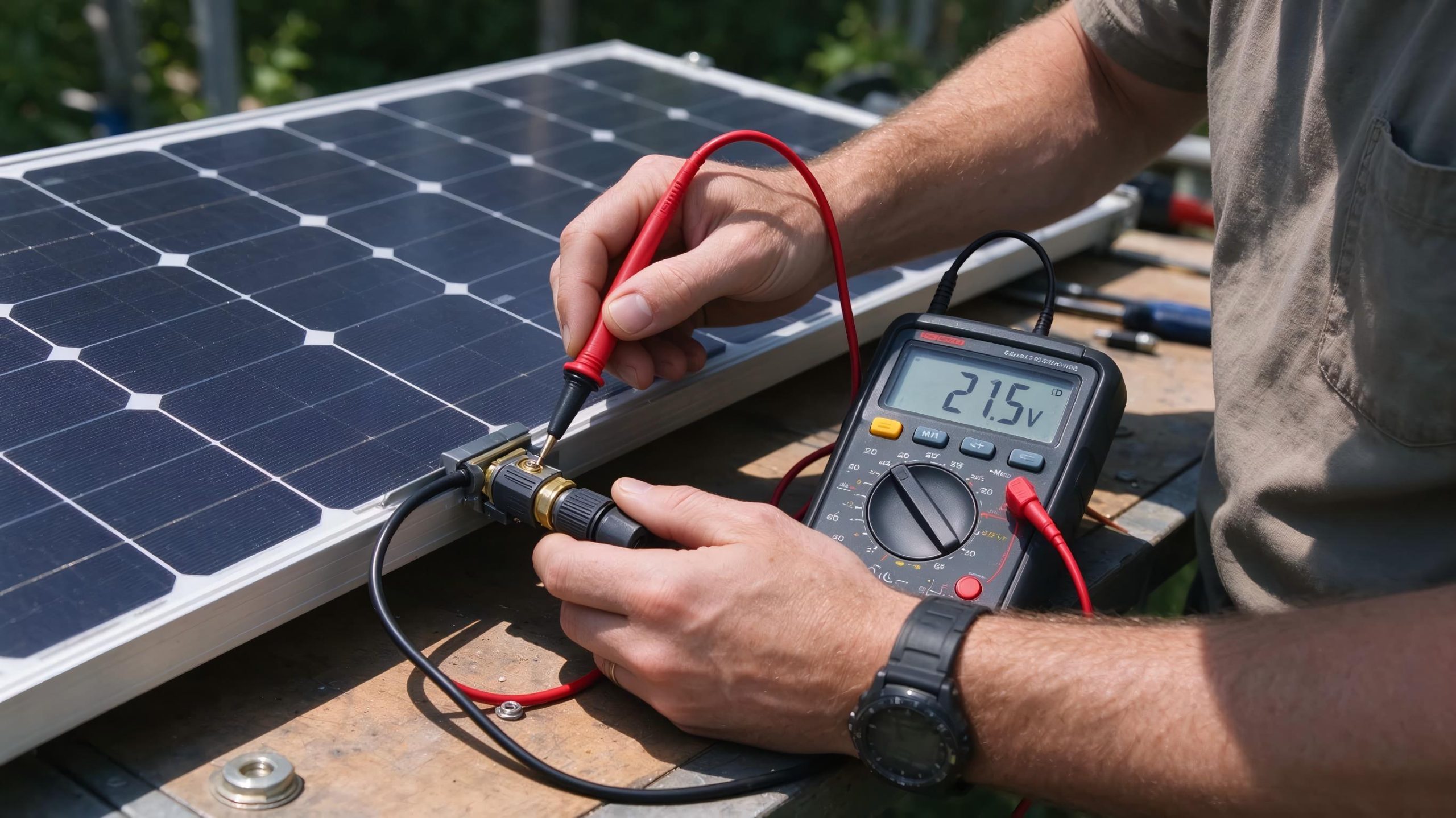
Testing solar panel voltage with a digital multimeter is a fast way to check whether a panel produces an open-circuit voltage close to its rated value. The key is to compare the reading against the manufacturer’s datasheet while accounting for cell temperature and test conditions. For a basic Voc check, you need a properly rated multimeter, insulated leads, and access to a panel you can electrically isolate. Set the meter to DC voltage, touch the probes to the positive and negative output terminals, and record the number. A normal Voc reading does not prove the panel produces its rated power. If the voltage is unexpectedly low, further checks separate environmental conditions, connection problems, and internal faults. Do not disconnect live PV connectors, do not open roof combiner boxes, and do not test high-voltage strings unless you are a qualified solar electrician.
What Are Solar Panel Voltage, Voc, and Vmp?
A solar panel output voltage test compares three different numbers. Mixing them up is the most common reason new builders think a panel is bad.
Voc is the voltage across the panel terminals with no load connected. The panel sits in the sun, the controller is disconnected, and the meter reads the highest voltage the silicon can produce. A typical 60-cell residential panel reads 38 to 42 volts at 25 degrees Celsius. A 36-cell 12V nominal panel reads 21 to 22 volts. These are typical values, not universal ones. The number on your panel’s own datasheet is the only value that matters.
Vmp is the voltage at maximum power, where the panel delivers its rated watts into a matched load. On the same 60-cell panel, Vmp sits around 30 to 36 volts. The operating voltage on the controller screen during charging is a third number. On a 12V system, it sits at the battery voltage, around 13.8 to 14.4 volts, not at Vmp. A panel rated at 21.6V Voc will never read 21.6V at the controller while charging. It reads 13.8V because the controller ties the panel to the battery. That is normal, not a fault.
What Tools and Safety Precautions Apply to a PV Panel Voltage Test?
A photovoltaic panel voltage test needs the right gear and the right boundary. Skip either, and the reading lies or the test becomes an arc flash risk.
-
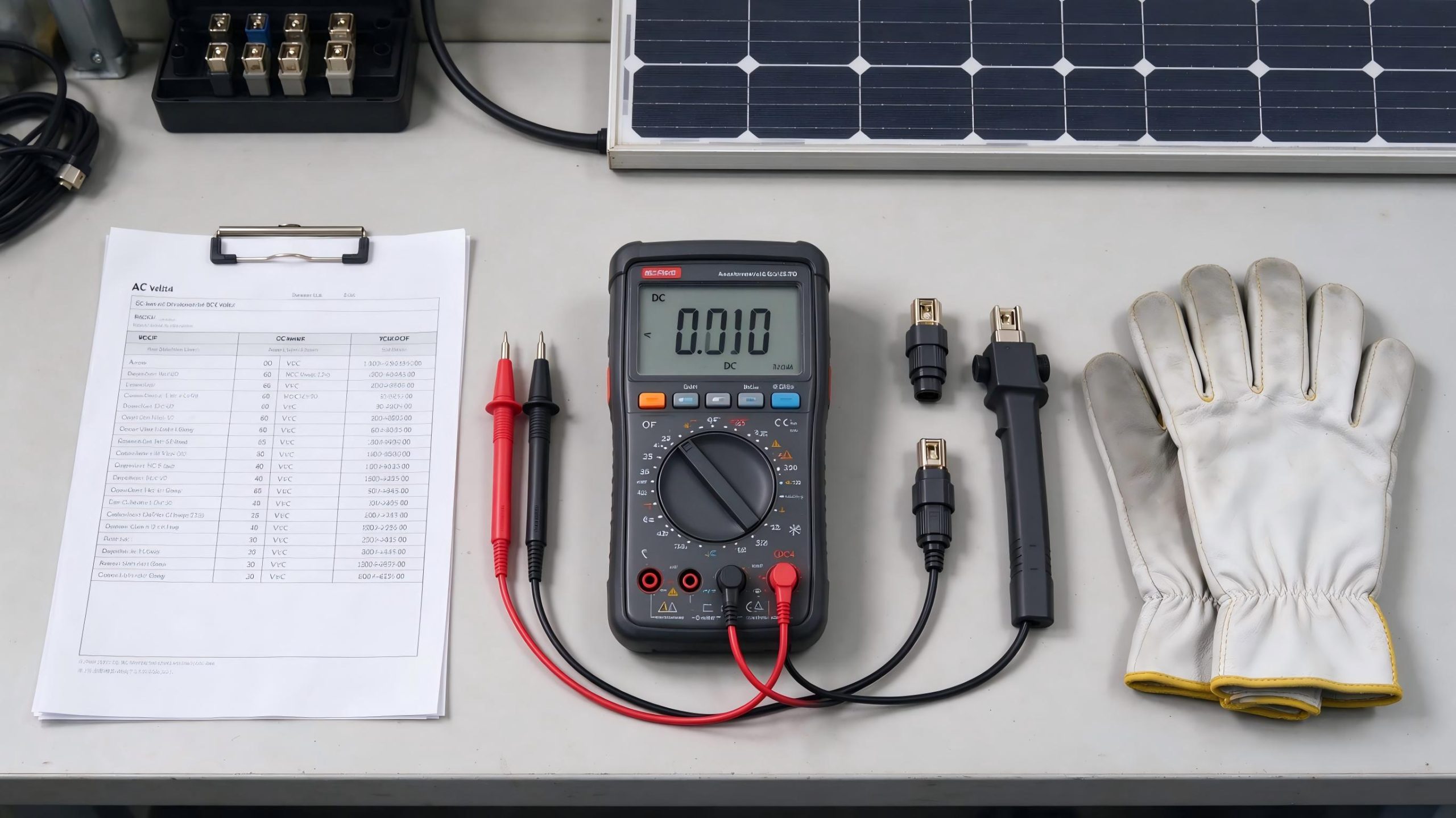
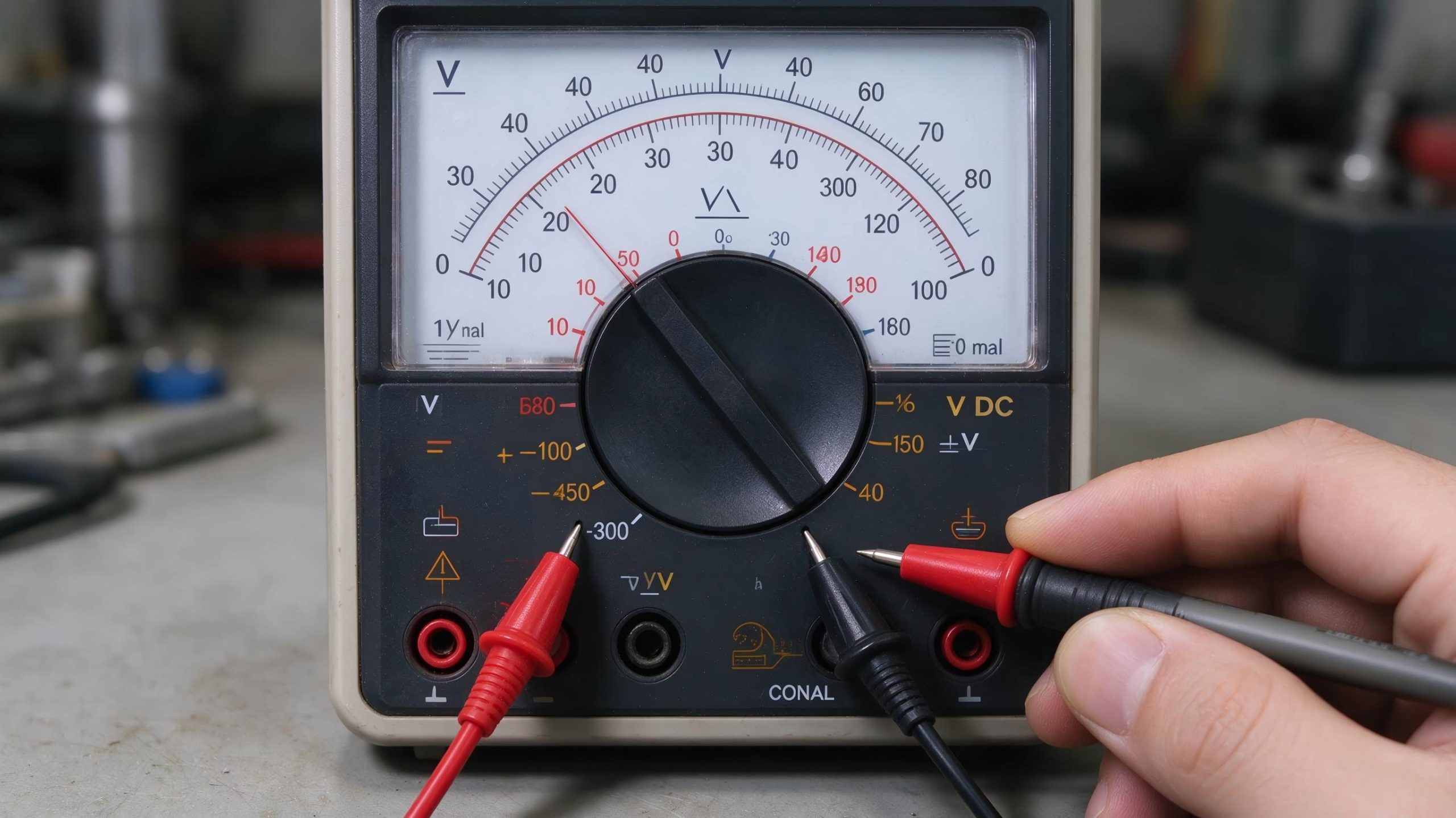
Digital multimeter rated for at least 600 volts DC, CAT III or better. A 0.1 volt resolution is enough. Do not use an analog needle meter, which loads the circuit.
-
Insulated test leads with undamaged probes, rated for the voltage you will measure.
-
The panel datasheet. Voc, Vmp, and the Voc temperature coefficient are printed on the silver label on the back. If the label is gone, pull the datasheet from the manufacturer by serial number.
-
PPE. Insulated gloves for anything above 60 volts. Safety glasses. No metal rings or watch bands.
When You Should Not Test It Yourself
Self-testing is appropriate for a single portable panel or a small 12V off-grid rig you can reach and isolate. It is not appropriate for roof-mounted arrays, 24V or 48V strings above 60 volts, commercial systems, or any panel you cannot disconnect following the manufacturer’s procedure. Never pull a live MC4 connector by the wire. Never break a load connection in mid-charging. If you are unsure whether the panel is isolated, stop and call a licensed solar electrician.
Test Solar Panel Voltage with a Multimeter
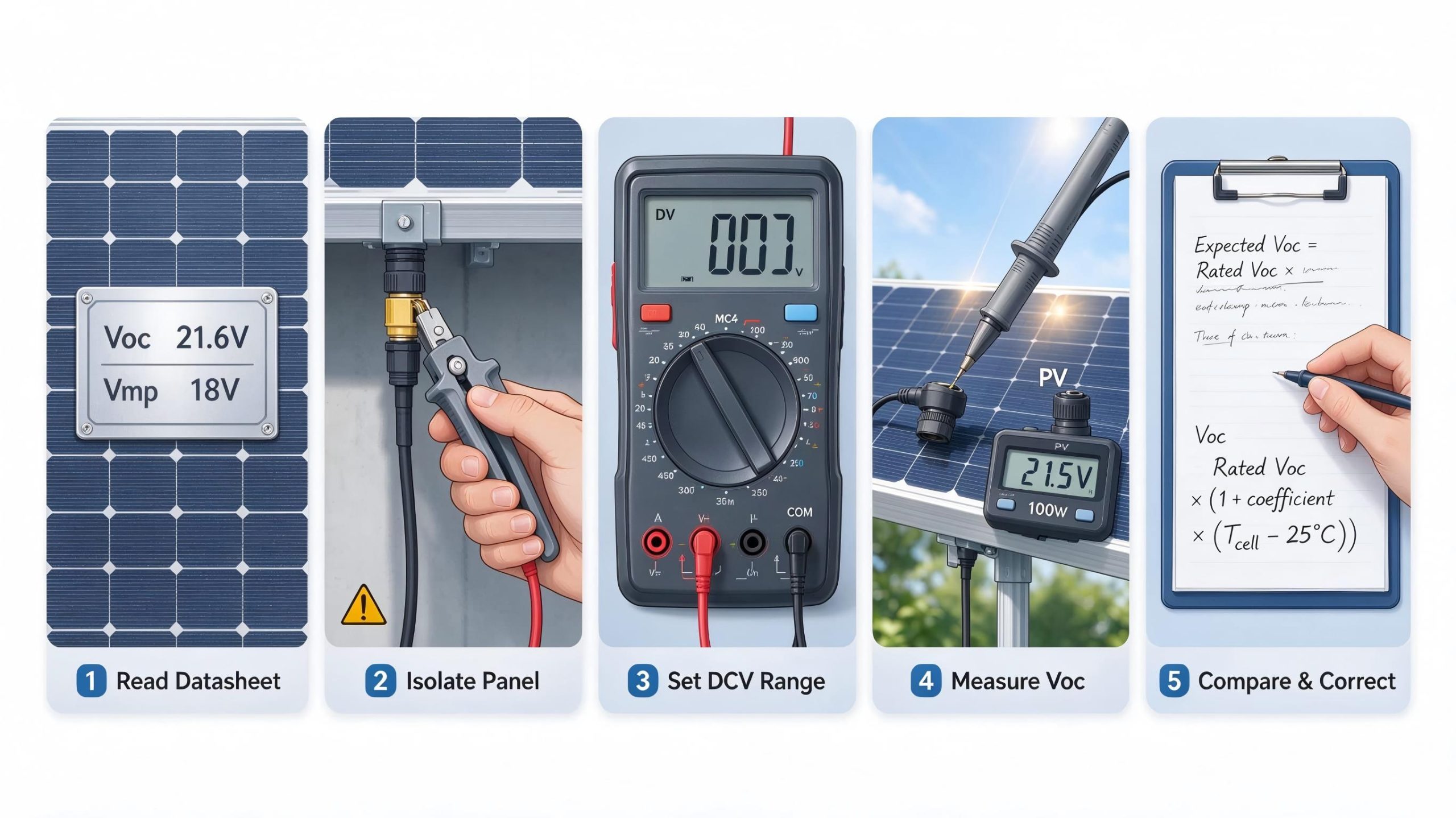
The PV module voltage test takes five steps. Test the panel in stable daylight with as little shading as possible, and record the conditions you measured in. The steps below apply to a single isolated portable panel. For a roof array, call a professional.
Step 1: Read the Datasheet First
Find the silver label on the back of the panel. Write down the rated Voc, Vmp, the temperature coefficient for Voc, and the rated power. A typical 100W 12V panel lists Voc at 21.6 volts, Vmp at 18 volts, and a temperature coefficient of minus 0.34 percent per degree Celsius. That coefficient is the number you will use to correct the reading later.
Step 2: Isolate the Panel Following the Manufacturer’s Procedure
Disconnect the panel from the charge controller following the manufacturer’s procedure. Never pull an MC4 by the wire. Never unplug a connector while the panel is feeding a load. Remember that an isolated panel is not de-energized. In sunlight, the open terminals still produce voltage. Set the panel in stable daylight with no shade on the cells. Wait a few minutes so the cells stabilize. This step applies only to portable or off-grid panels you can safely isolate. Do not open roof combiner boxes you are not licensed to open.
Step 3: Set the Multimeter to DC Voltage
Turn the dial to DC voltage, marked V with a straight line. Select a range above the panel’s expected open-circuit voltage, including the rise caused by cold temperatures. For a panel rated at 21.6V Voc, use a higher suitable range such as the 200V range on a manual-ranging meter, or an appropriate auto-ranging setting. A 20V range will not display 21.6V correctly. Plug the red lead into the voltage jack marked V ohm. Plug the black lead into the common jack marked COM. Never put the red lead in the current jack for a voltage test. That turns the meter into a short circuit and blows the internal fuse.
Step 4: Touch the Probes to the Isolated Terminals
Use compatible PV test adapters or properly rated test leads designed for the panel’s connectors. Do not insert ordinary meter probes into MC4 connector openings. Measure the voltage across the positive and negative output terminals, following the test equipment manufacturer’s instructions. The meter locks the reading in two seconds. Reverse the leads and the meter shows a negative number, which confirms polarity and is normal on a digital meter. A panel exposed to sunlight can still produce voltage even when it is disconnected from the rest of the system. If you cannot safely isolate the panel from the connected equipment, stop and consult a qualified solar electrician.
Step 5: Record, Correct for Temperature, and Compare
Write the reading down. Then estimate the Voc you should expect at the current cell temperature, using the datasheet coefficient. Compare the measured reading against that expected number. The next section walks through the formula.
How Temperature Changes Open-Circuit Voltage
A solar panel operating voltage reading is only meaningful after you account for cell temperature. Voc rises as cells cool and drops as cells heat up. The correction is not a fixed 0.3 volts per 10 degrees. It is a formula built on the panel’s own coefficient.
Use the temperature coefficient of Voc from the datasheet. Most manufacturers list it as a percentage per degree Celsius. Convert it to decimal form. Then run this estimate:
Estimated Voc = Rated Voc × [1 + Voc coefficient × (cell temperature − 25°C)]
Worked example. For illustration, assume the actual cell temperature is 5 degrees Celsius. A 100W panel rated at 21.6V Voc with a coefficient of minus 0.34% per degree Celsius uses a decimal of minus 0.0034. The estimated Voc is 21.6 × [1 + (minus 0.0034) × (5 − 25)] = 21.6 × 1.068 ≈ 23.1 volts. On a 45 degree Celsius rooftop, the same panel’s expected Voc is 21.6 × [1 + (minus 0.0034) × (45 − 25)] ≈ 20.1 volts. Both numbers describe the same healthy panel. This is an illustrative calculation, not a prediction based on outdoor air temperature alone. Cell temperature depends on irradiance, wind, and mounting. For a meaningful field comparison, use the best available estimate of actual cell temperature and apply the manufacturer’s tolerance bands.
Frequently Asked Questions
Most solar panel voltage questions circle back to the same three points: what a normal reading looks like, when a low number means a fault, and when the job is outside a DIY scope. The answers below cover the five we see most often, using the same Voc, Vmp, and temperature logic from the steps above.
Can You Test a Solar Panel with a Multimeter?
Yes, for a panel you can safely isolate. Set the meter to DC voltage, range above the panel Voc, and touch the probes to the output terminals. A 600V CAT III digital multimeter covers most portable and 12V panels. Do not test roof arrays or strings above 60 volts yourself.
What Voltage Should a 12V Solar Panel Read?
A 12V nominal panel is a 36-cell module. Its Voc typically reads 21 to 22 volts at 25 degrees Celsius, corrected for temperature. A reading around 12V in full sun is lower than expected for many such panels. Check the test setup, sunlight, connections, and the datasheet before calling the panel faulty.
Why Is My Solar Panel Showing 0 Volts?
Several causes. The panel is in shade. The probe is not making contact. The MC4 connector has pulled apart. Or the bypass diode in the junction box has failed open. Check the connector and the meter setting first. If the panel still reads zero after a clean test, call a technician.
Can a Solar Panel Have Normal Voltage but Produce No Power?
Yes. A panel can read full Voc while producing low current. Cracked cells, partial shading, and degraded substrings limit Isc without moving Voc much. Catching that fault needs a properly rated PV test instrument and the right procedure, not just a voltage meter on the output terminals.
Is It Safe to Test Solar Panel Voltage Yourself?
Yes, for a single isolated portable panel. No for roof arrays, strings above 60 volts, or any system you cannot disconnect following the manufacturer’s procedure. Wear insulated gloves and safety glasses, and never short the probes across the terminals. When in doubt, call a qualified solar electrician.
Five Minutes with a Meter Beats a Winter of Guessing
A solar panel voltage test tells you whether the open-circuit reading lines up with the datasheet. Read the label. Isolate the panel. Set the meter to DC voltage. Touch the probes to the terminals. Correct the reading for cell temperature using the panel’s own coefficient. Close to the corrected value means the panel Voc is fine. Noticeably low means check the sun, the connections, and the clean glass before you diagnose an internal fault. Zero volts means verify the setup before you call the panel dead. Treat Voc as a screen, not a verdict. Leave the roof arrays and the high-voltage strings to the licensed electrician. The portable panel on the lawn is yours to test. Match the number to the datasheet, account for the cold morning, and the next charging problem stops being a mystery.