

Most buyers shop by wattage. That’s the first mistake. Wattage tells you how fast power flows out. Watt-hours tell you how long it lasts. A 2,000W unit with a 500Wh battery runs your coffee maker for 20 minutes. A 1,000W unit with 3,000Wh keeps your fridge cold for three days. Buy the wrong size, and you’re out of power by 9 PM — every single night.
The Mistake Most RV Owners Make
They focus on peak wattage, not battery capacity. Battery capacity determines whether you wake up with power. Inverter wattage determines what you can run at once. Both matter — but capacity is what most people get wrong first. A massive inverter with a small battery is like a sports car with a one-gallon fuel tank. It looks impressive on paper. It won’t get you far off the pavement.
How to Calculate Your Daily Power Need
List every device you use daily. Multiply each device’s wattage by its hours of use. Add them up.
Common RV loads:
- 12V compressor fridge: 40–80Wh/day
- LED lighting: 10–25Wh/day
- Laptop + phone charging: 60–120Wh/day
- Water pump: 5–15Wh/day
- CPAP machine (no heat): 30–60Wh/night
- Rooftop AC (13,500 BTU): 600–750Wh per hour
A two-person RV without AC typically uses 450–750Wh per day. Add regular AC use, and that climbs to 1,500–2,500Wh or more. Once you have your daily number, multiply by 1.5. That buffer covers cloudy days, real-world inefficiencies, and unexpected loads. A 600Wh daily draw means you need at least 900Wh of usable capacity to sleep easily.

How to Choose a Solar Generator for RV Use
This is where specs either earn their place or become marketing noise. Here’s what actually separates a reliable unit from one that fails you three days into a boondocking trip.
Battery Chemistry — LiFePO4 Is the Only Choice
LiFePO4 (lithium iron phosphate) lasts 3,000–6,000 charge cycles. It handles heat and cold better than NMC chemistry. It’s thermally stable — critical inside a sealed RV storage bay.
Three units that deliver on every count:
- EcoFlow Delta Pro — 3,600Wh base, expandable to 25kWh
- Bluetti AC200MAX — 2,048Wh with dual expansion ports
- Jackery Explorer 2000 Plus — 2,042Wh, clean interface, easy for non-technical users
All three use LiFePO4 cells. All three ship with pure sine wave inverters. These three models have been proven reliable for extended, multi-season use in RVs.
Inverter Type and Surge Rating
Always choose a pure sine wave. Modified sine wave costs less upfront — and damages motor-driven appliances over time. It also causes CPAP machines to run inefficiently. Don’t risk your equipment to save $50. Surge rating matters especially for air conditioning. A standard 13,500 BTU rooftop AC spikes to 2,800–3,500W at startup. Your inverter needs a surge rating of at least 4,000W to handle that without tripping its protection circuit.
Charge Controller — MPPT vs PWM
MPPT controllers extract 20–30% more power from panels than PWM under real-world conditions — partial shade, shifting sun angles, temperature swings. On a 400W panel array, that gap means 320–480Wh of extra daily harvest. Over a week of boondocking, the difference is a full extra day of power. Every serious RV solar setup needs MPPT. It’s not optional.
Solar Panel Sizing Made Simple
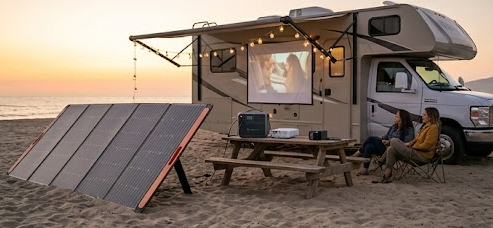
Divide your daily Wh consumption by 4. That’s your minimum panel wattage, assuming 4–5 peak sun hours per day. A 700Wh daily load needs at least 175W of panels — though 300–400W gives you a reliable real-world margin. One tip most RV owners skip: add a portable ground panel. Roof panels can’t always face the sun directly. A 200W portable panel angled toward direct sun adds 40–60% more harvest on shaded or cloudy sites. Full-time RV solar users consider it essential.
Full-Time RV Living vs Weekend Camping
Weekend campers need 1,000–2,000Wh and 200–400W of panels. Portability matters more than raw capacity at this level. Occasional shore power fills the gaps. Full-time living is a different equation. You’re running a refrigerator 24/7. You may be working remotely — router and laptop power all day. Climate control runs longer and harder. Start at 3,600Wh minimum. Most experienced full-timers end up at 6,000–10,000Wh with 600–1,000W of roof panels. Reliability isn’t optional for full-timers. Build in a backup charging source — vehicle alternator input or shore power fallback — from day one.
Winter Camping and Your Solar Generator for RV
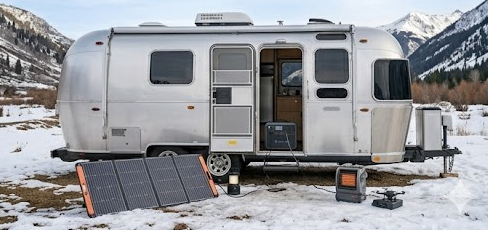
Two things change in winter. First, solar harvest drops — lower sun angles, shorter days, more cloud cover. Plan for 30–50% less daily output compared to the summer months. Second, heating loads spike. A propane furnace blower draws 150–300W continuously. On a cold night, that adds 1,000–2,000Wh to your daily consumption. Size your system around those numbers if you camp year-round. One hard rule for LiFePO4 in cold weather: never charge below 32°F (0°C). Charging in freezing temps causes lithium plating — permanent capacity loss that no warranty replaces. Units like the EcoFlow Delta Pro include built-in battery heaters that activate automatically below freezing. Worth paying for if you winter camp regularly.
Size Up Your Solar Generator for RV
Calculate your real daily load. Add 50%. Match your battery, inverter, and solar input to that number — not a spec sheet. For most RV travelers: 2,000Wh LiFePO4 + 400W panels + MPPT controller. For full-timers and boondockers: start at 4,000Wh with a unit that supports expansion. The right solar generator for RV travel doesn’t just power your rig. It removes the constraint of where you can go. Get the sizing right, and the campsites that open up will make the research feel trivial.