
The 2026 solar market is not what it used to be. A major policy change has shifted the rules — and many homeowners still haven’t caught on. The federal residential solar tax credit (Section 25D) expired on December 31, 2025. That 30% credit used to be the clearest argument for buying outright. Now, lease and PPA companies still qualify for the 30% credit through their commercial status, and competitive providers pass those savings to customers through lower monthly rates — narrowing the gap between leasing and buying significantly. Understanding this shift is the starting point for any honest comparison. Where you live, how long you plan to stay, and what your utility rate looks like all feed into the final answer.
Here’s the Short Answer on Solar Lease vs Buy Savings
Buying still wins long-term. Leasing wins on accessibility and simplicity. Cash purchases and solar loans still generate the most lifetime savings — typically $55,000–$65,000 on a standard 8kW system over 25 years. Leases and PPAs produce 30–40% less in lifetime savings than ownership, while offering $0 upfront cost, no maintenance responsibility, and immediate monthly bill reduction. For homeowners with a tight budget or a shorter time horizon, leasing removes the financial barrier entirely. However, every dollar saved on upfront costs comes at the expense of long-term returns. The right answer depends entirely on your timeline, state incentives, and how much capital you want to commit upfront. In states where electricity rates exceed $0.20/kWh, the ownership advantage remains strong — even without the federal tax credit.
Solar Lease vs Buy: Cost Comparison with Real 2026 Numbers
Here’s a realistic side-by-side for an 8kW residential system:
| Solar Lease | Solar Purchase | |
|---|---|---|
| Upfront cost | $0 | ~$22,000–$30,500 |
| Federal tax credit | Goes to lessor | Expired for buyers |
| Monthly payment | ~$80–$130 | $0 (post-loan payoff) |
| 25-year total savings | ~$33,000–$45,000 | ~$55,000–$65,000 |
| System ownership | Leasing company | You |
| Home value added | Minimal | ~$4/watt added |
Solar loan rates average 7–9% APR in 2026. Some loans carry hidden dealer fees that inflate the financed amount by 15–30%. Factor those in before signing. In high-rate states, ownership still pays off faster — even without the federal credit.
Breaking Down the Real Benefits on Each Side
Why leasing works for some homeowners:
- Zero upfront investment
- Maintenance and repairs are covered by the provider
- Lease payments are locked in for 20–25 years, acting as a hedge against future utility rate increases
- Easier credit approval — most leases require only a soft check and a FICO score around 650
Why buying still delivers more:
- Maximum long-term savings over 25 years
- Owned solar adds approximately $4/watt in appraised home value — leased systems do not reliably add resale value
- Full control over storage upgrades and system expansion
- No third-party contract complications when selling
Both options cut your electricity bill. The difference is who captures the most value — and over what timeframe.
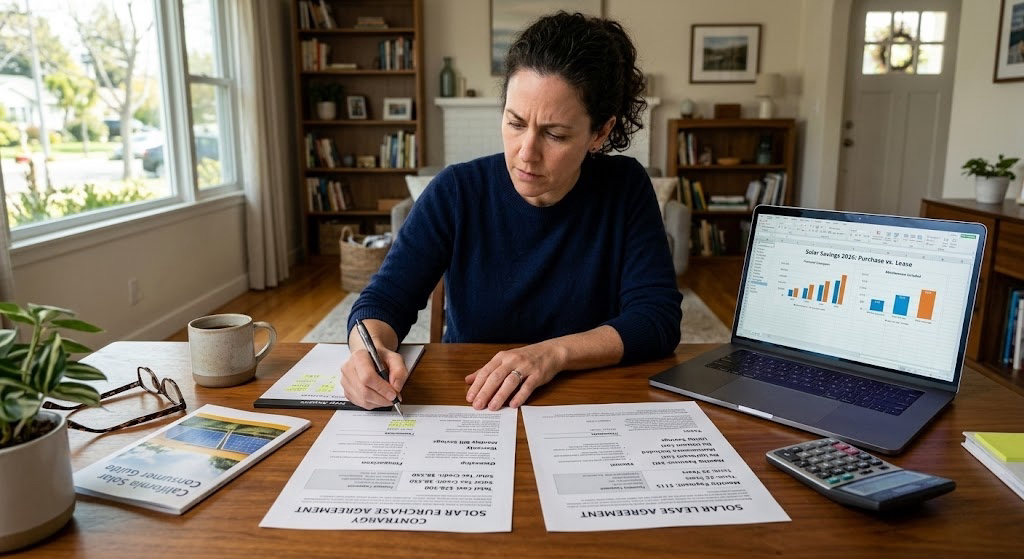
When Each Option Makes More Sense for Solar
Lean toward leasing if:
- You need to start saving immediately with no cash outlay
- You plan to move within 5–7 years
- Your state offers limited solar incentives
- You want zero maintenance responsibility
The shorter your horizon, the less ownership’s long-term advantage matters.
Lean toward buying if:
- You plan to stay in your home for 10+ years
- Your state has strong incentives (NJ, NY, CT, RI offer significant programs)
- Your utility rate exceeds $0.16/kWh
- You’re adding battery storage now or planning to
Neither choice is wrong. But time at home is the single factor that tips the scales more than anything else — including price.
Solar Lease vs Buy: Making the Right Call for Your Home
The expiry of the residential ITC levelled the playing field — but buying still leads on total lifetime value for most homeowners who plan to stay put. A typical purchased system pays for itself in 10–13 years and saves $40,000–$60,000 over 25 years for homeowners paying above $0.20/kWh. If those numbers fit your situation, ownership remains the stronger financial move. If budget or timeline make leasing more practical, don’t dismiss it. A well-structured lease still cuts your electricity bill from day one. The key is reading the escalator terms carefully — an escalator of 3% versus 0% can translate to thousands of dollars more in total payments over the lease term. Run your real utility rate and state incentives through a solar calculator before deciding. The right option is the one built around your specific numbers — not a general rule.