
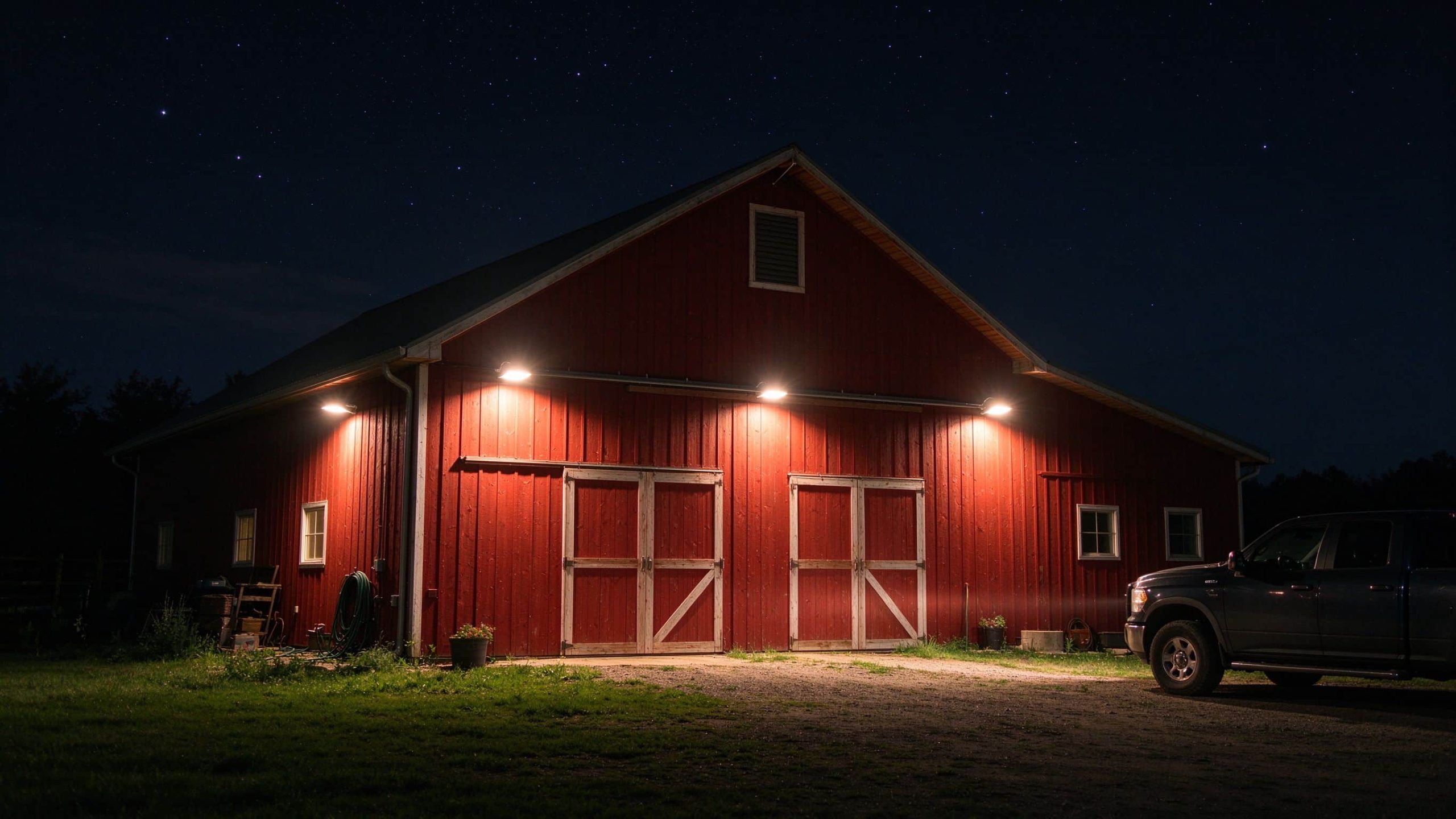
A solar barn light lights a stall, aisle, or farm lane with no trench, no breaker, and no electrician. The fixture mounts on a post or wall, charges from the sun during the day, and switches on at dusk. It pays off when the barn is too far from the house to run wire cheaply, when the extension cord across the paddock keeps tripping, or when you just need a safe trip out to the heifer at 2 a.m. The right setup depends on three things: the size of the space you are lighting, whether you want constant-on or motion sensing, and how many lumens the job actually needs. Pick the brightness for the room, mount the panel where the sun hits all day, and let the photocell do the switching.
What a Solar Barn Light Looks Like on a Working Farm
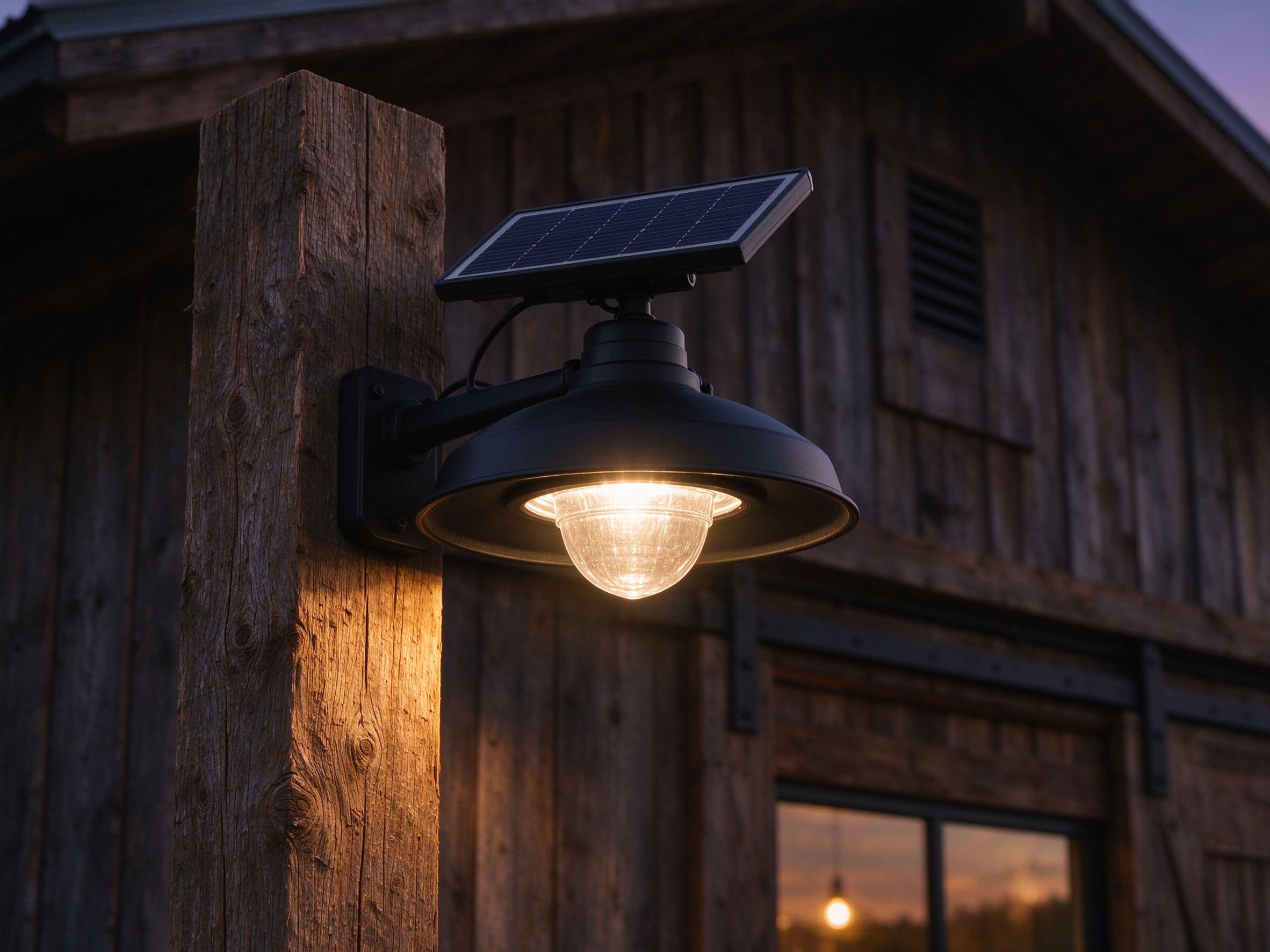
A solar barn light is a sealed LED fixture that bundles four parts in one housing: a small crystalline solar panel on top, a lithium iron phosphate (LiFePO4) battery behind it, a driver board with a dusk-to-dawn photocell, and the LED array itself. No separate controller, no separate battery box, no wiring between them. A typical 400 lumen unit pairs a 5W monocrystalline panel with a 7.4V 4,400 mAh battery. On a full day of sun, that stores roughly 32 watt-hours. Run at 3W, the fixture stays on for 10 to 12 hours straight. On the motion-sensing setting, it holds 20 percent brightness overnight and jumps to full when you walk within 5 meters, which stretches the same charge to three or four nights without a recharge.
|
Mode
|
Power draw
|
Runtime on 32 Wh
|
Best for
|
|---|---|---|---|
|
Constant on, full brightness
|
3W continuous
|
10–12 hours
|
Calving pen, foaling stall
|
|
Dusk-to-dawn dim
|
0.6W (20% brightness)
|
48–53 hours
|
Overnight aisle lighting
|
|
Motion sensing
|
0.6W idle, 3W on trigger
|
3–4 nights
|
Lanes, barnyard doors, tack rooms
|
|
Off all day, on only at dusk
|
3W for 6 hours
|
4–5 nights
|
Low-traffic storage sheds
|
The install is one drill and two lag bolts. The panel faces south at a 30 to 45 degree angle so it picks up the low winter sun. The housing carries an IP65 or IP66 rating, which means it survives a pressure wash, a snow load, and a -20°C night. Compare that to a standard outdoor LED that fails after one wet spring because the driver board is not sealed.
The Purpose of Solar Barn Lights After Dark
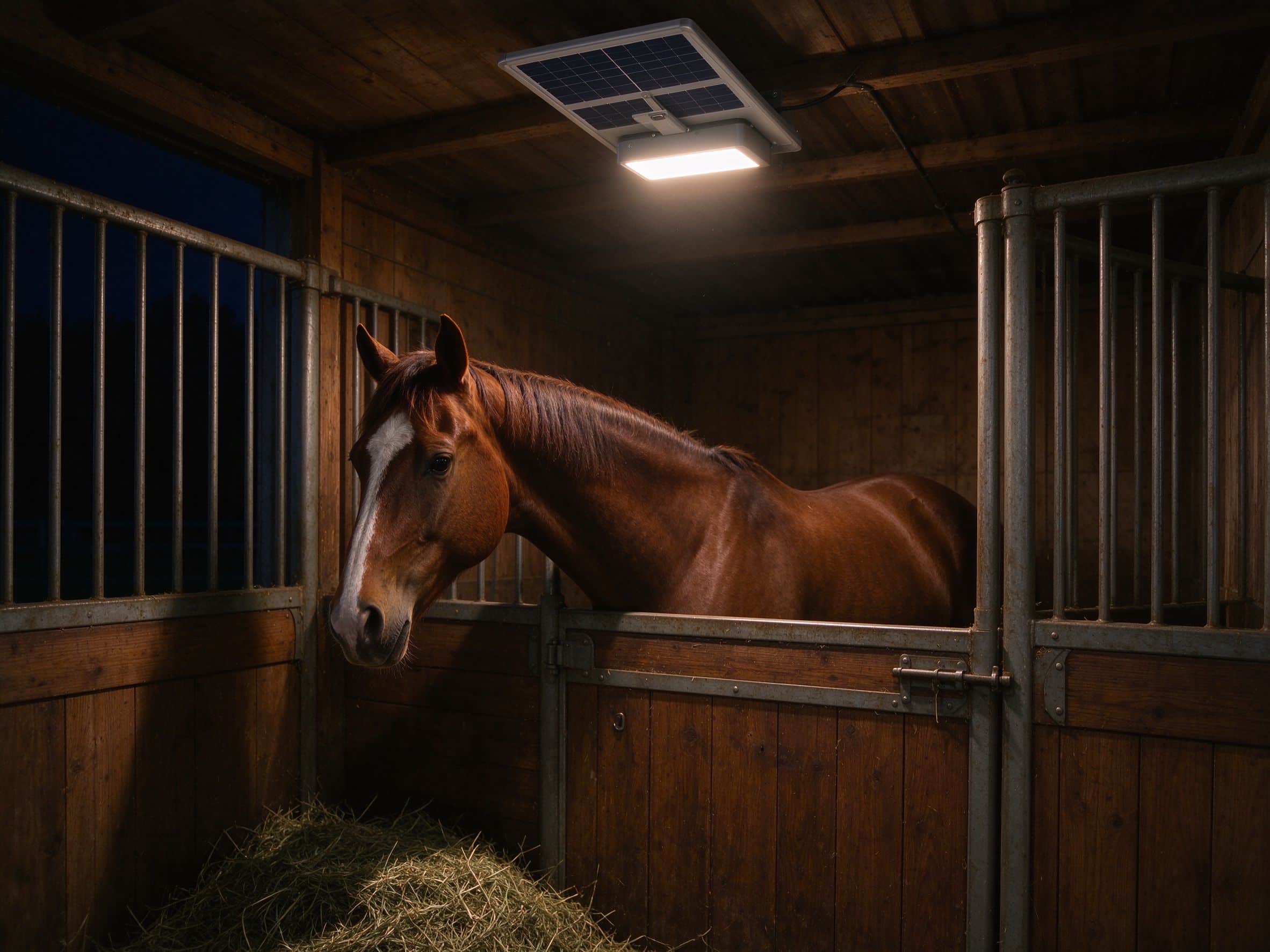
The purpose of solar barn lights is not decoration. It is safety and routine. You check the water trough at 10 p.m. And lock up the tack room after the evening ride. You walk out to the heifer that is about to calve at 2 a.m. A lit aisle means you are not stepping in a bucket or tripping over a hose in the dark. It also means the dog does not get to decide what goes bump in the night.
Good lighting also cuts two real farm costs. First, you stop buying batteries for the handheld flashlight that dies every other month. Second, you stop fumbling with a headlamp that leaves your hands full. A motion-sensing barn light burns only when you actually walk through, so the battery lasts the whole night instead of dying by 11 p.m.
-
Stall aisles stay lit between evening feed and morning check.
-
Tack rooms and feed rooms are safe to enter without a flashlight.
-
Loafing sheds and calving pens stay visible overnight.
-
The barnyard door is lit when you pull in after a late market run.
Other Applications for Solar Barn Lights Beyond the Stall
Applications for solar barn lights spread fast once the first one goes up. Farmers who start with a stall light end up putting fixtures on the lane, the coop, and the well house. The same sealed housing that works over a horse stall also works over a dog kennel, a chicken coop, or a goat shelter, because none of those spots have power nearby either.
-
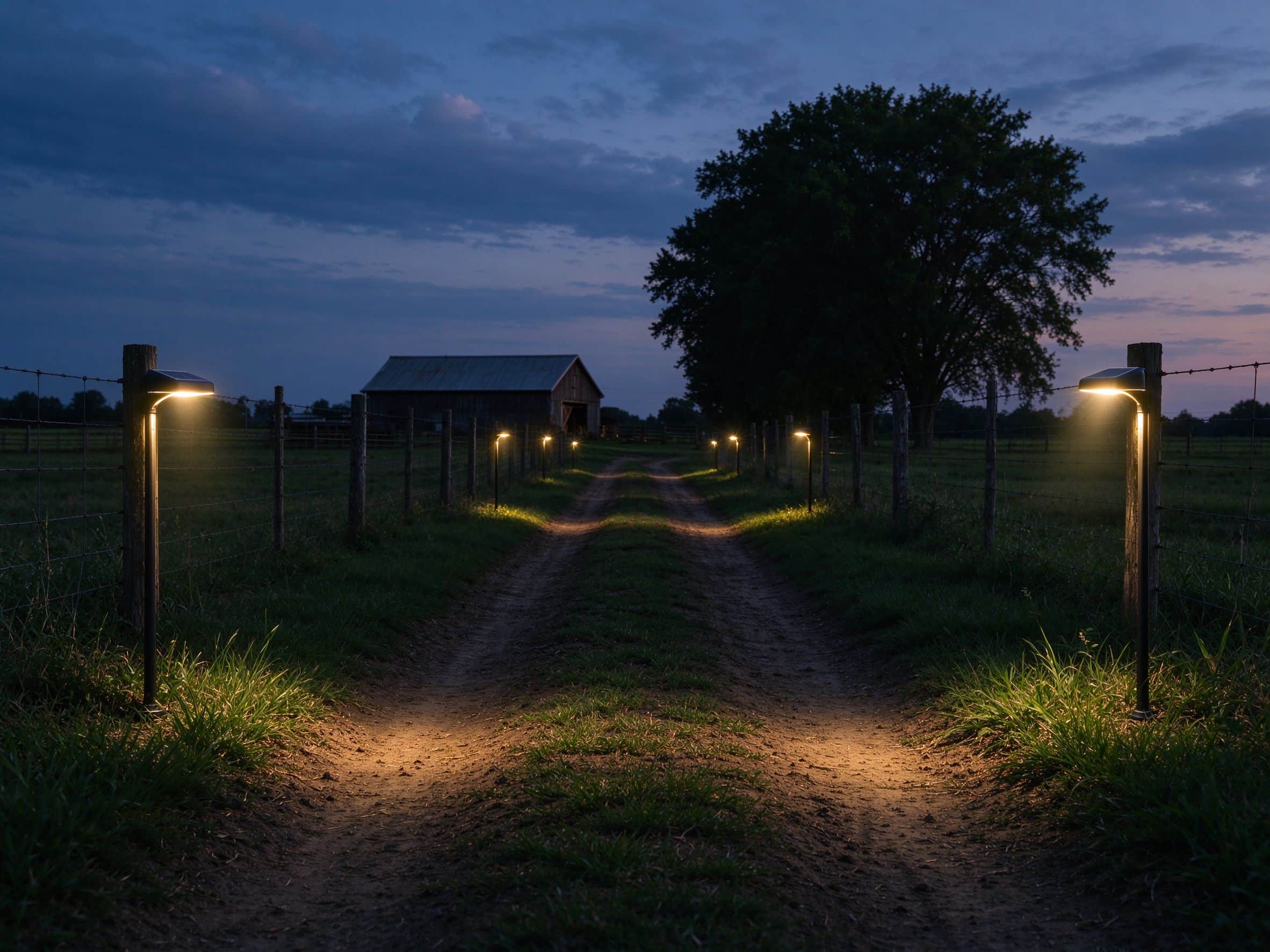
Farm lanes and driveways. Post-mounted lights on both sides mark the way home after dark. Motion sensing keeps them dim until a vehicle approaches.
-
Coops and kennels. A low-wattage fixture keeps the birds and dogs visible without frying them in summer.
-
Well houses and pump sheds. A light outside the pump shed means you can check the pressure gauge without fumbling.
-
Arena turnout yards. A pair of flood fixtures on the arena fence lets you ride or feed after sunset.
Anywhere you would otherwise run an extension cord, a solar fixture earns its place.
Pick the Right Brightness for the Job
Brightness is the one spec you cannot guess. Lumen output tells you how much light comes out of the fixture, but what actually lands on the ground depends on mounting height and beam angle. For instance, a fixture mounted 3 meters up spreads the same lumens over four times the area of one mounted 1.5 meters up. That is exactly why a 1,000 lumen flood on a tall pole washes out the barnyard, while a 500 lumen fixture at 2 meters lights a workbench cleanly.
With that in mind, work backward from the lux level the task actually needs. A walkway or aisle only needs 20 to 50 lux on the ground. A stall where you hand milk or clean tack, by contrast, needs 100 to 150 lux. A workbench, a calving pen, or an arena where you ride after dark needs 200 to 300 lux. As a rule of thumb, multiply the floor area in square meters by the target lux and divide by roughly 60 to get the lumens you need from a fixture with a standard 120-degree beam. Put another way, a 4 meter by 4 meter aisle at 50 lux needs about 1300 lumens spread across two fixtures, not one 1,000 lumen flood in the middle.
Three Numbers and the Barn Lights Itself
In the end, a solar barn light earns its keep when you match three numbers to the space. First, pick the lumen output for the task: 200 to 400 for a lane, 500 to 800 for a stall aisle, 1,000 or more for an arena. Second, choose the mode: motion sensing for a lane you pass twice a day, constant-on for a calving pen you check every hour. Third, mount the panel where the sun hits it from morning to afternoon so the 32 Wh battery refills before the next dusk. Skip any of those three and the light either glares, dies at midnight, or never turns on at all. Get them right, however, and the trip out to the barn stops being a chore.